American Politics, Progressive News, Human Rights, Civil Disobedience, Foreign Policy, Current Events, Cultural Activism, and Social Justice.
http://www.dustcircle.com | http://www.facebook.com/dissentingheretic | http://www.twitter.com/dustcirclenews
Showing posts with label morality. Show all posts

Thursday, April 25

@dustcirclenews - HEADLINES: #CISPA, Mess Oil Made, America #1 Terrorism Sponsor, Boston Bomber Case, Armenian Genocide, Obama vs. Whistleblower Protections, US Inequality Continues, Confront Corporate Personhood, Renounce the War on Terror, Game of Drones, Walmart Workers Won't Rest, Factory Farm Cruelty, America #1 in Fear and Depression, Low IQ and Right-Wingers, Why Brainwash Kids? more.

You are viewing this email from DUSTCIRCLE.COM. 
Click the links below to view complete article.

CISPA - Corporations Buy Politicians and Your Privacy

The 'mess' that oil made
http://www.aljazeera.com/programmes/insidestoryamericas/2013/04/20134247553691966.html

America: The World’s Number One Sponsor Of Terrorism
http://www.informationclearinghouse.info/article34710.htm

Balancing the State and Federal Roles in Boston Bomber Case
http://sentencing.typepad.com/sentencing_law_and_policy/2013/04/balancing-the-state-and-federal-roles-in-boston-bomber-case.html

Israel: The Politics Behind The Armenian Genocide
http://axisofjustice.net/israel-the-politics-behind-the-armenian-genocide/

Obama Poised to Deliver Another Blow to Whistleblower Protections
http://www.motherjones.com/politics/2013/04/obama-whistleblower-case-national-security-sensitive

Report: Wealthy Thrive and Poorest Dive as Surge in US Inequality Continues
http://www.commondreams.org/headline/2013/04/24-3

Confront Corporate Personhood: Take Back our Planet
http://www.opednews.com/articles/Confront-Corporate-Personh-by-Kaitlin-Sopoci-Bel-130424-769.html

The White House's Flawed Korea Policies
http://www.opednews.com/articles/The-White-House-s-Flawed-K-by-Conn-Hallinan-130425-255.html

Time to Renounce the "War on Terror"
http://www.opednews.com/articles/Time-to-Renounce-the-War-by-Norman-Solomon-130424-739.html

Obama and the game of drones
http://socialistworker.org/2013/04/24/obama-and-the-game-of-drones

Wal-Mart workers won't rest
http://socialistworker.org/2013/04/24/walmart-workers-wont-rest

Why It's Literally Sickening to Ban Whistleblowers from Exposing Cruelty at Factory Farms
http://www.alternet.org/food/why-its-literally-sickening-ban-whistleblowers-exposing-cruelty-factory-farms

'Terrorism' and the Perpetual Emotion War Machine
http://www.commondreams.org/view/2013/04/24

Why hackers love Twitter
http://www.allvoices.com/contributed-news/14470131-why-hackers-love-twitter

America: #1 In Fear, Stress, Anger, Divorce, Obesity, Anti-Depressants, Etc.
http://www.thedailysheeple.com/america-1-in-fear-stress-anger-divorce-obesity-anti-depressants-etc_042013

Every Time a Bomb Goes Off, The Surveillance State Grows Stronger
http://www.informationclearinghouse.info/article34725.htm

10 facts about enemy combatants
http://www.politico.com/story/2013/04/what-is-an-enemy-combatant-90436.html

When Israeli Denial of Palestinian Existence Becomes Genocidal
http://www.informationclearinghouse.info/article34720.htm

IRS Says It Will Change Its Policy On Looking At Emails Without A Warrant... At Some Point
http://www.techdirt.com/articles/20130421/23062122797/irs-says-it-will-change-its-policy-looking-emails-without-warrant-some-point.shtml

Yet Another Study Shows Low IQ And Right-Wing Ideology Go Hand-In-Hand
http://www.addictinginfo.org/2013/04/24/yet-another-study-shows-low-iq-and-right-wing-ideology-go-hand-in-hand/

Why Brainwash Kids?
http://new.exchristian.net/2013/04/why-brainwash-kids.html

Godless Morality and Ethics: Being Good Without Gods or Religion is Possible
http://atheism.about.com/od/ethicsandculture/p/GodlessMorals.htm?nl=1

Thursday, January 24

24.Jan.2013 - HEADLINES: Drones, Government Surveillance, Global Warming, Immigrant Citizenship, Obama's War, Customer Beware, Military Suicides, Religion Doomed, Capitalism, Scientology Self-Destructing, Wiretapping Everyone, World's Wealthiest, more.

Greetings from The Dissenting Heretic!
This is a free service, and done in free time. If you'd like to donate to us, even $1.00 helps maintain the site. Click the WePay link on the website to donate any amount. Thank you!

Making ‘Lethal Drones’ Routine
http://consortiumnews.com/2013/01/22/making-lethal-drones-routine/

Google Report Shows 'Disturbing Growth in Government Surveillance'
http://www.commondreams.org/headline/2013/01/23-8

Global Warming is a Domestic Crisis
http://www.commondreams.org/view/2013/01/23-0

Obama's Overlooked War and Lethal Presidency
http://www.informationclearinghouse.info/article33683.htm

Nearly 2/3 of Americans Support for Path to Citizenship for Immigrants -- But Will Obama Step Up?
http://www.alternet.org/immigration/nearly-23-americans-support-path-citizenship-immigrants-will-obama-step

Customer Beware: You Are Being Tracked
http://www.alternet.org/civil-liberties/customer-beware-you-are-being-tracked

Military Suicides Outpace Combat Deaths
http://readersupportednews.org/news-section2/323-95/15573-military-suicides-outpace-combat-deaths

Does the Internet Spell Doom For Organized Religion?
http://www.informationclearinghouse.info/article33630.htm

The Institutionalization of Tyranny
http://www.informationclearinghouse.info/article33670.htm

The Extremist Cult of Capitalism
http://www.opednews.com/articles/The-Extremist-Cult-of-Capi-by-Paul-Buchheit-130121-441.html

The case for socialist organization
http://socialistworker.org/2013/01/16/case-for-socialist-organization

After Tragedy, Nonbelievers Find Other Ways To Cope
http://www.npr.org/2013/01/16/168563480/after-tragedy-nonbelievers-find-other-ways-to-cope

Is Scientology self-destructing?
http://machineslikeus.com/news/scientology-self-destructing

How The FBI's Desire To Wiretap Every New Technology Makes Us Less Safe
http://www.techdirt.com/articles/20130114/20442421683/how-fbis-desire-to-wiretap-every-new-technology-makes-us-less-safe.shtml

Profits of World's 100 Wealthiest Could End Poverty Four Times Over: Report
http://www.commondreams.org/headline/2013/01/21-0

Texas Public School Teaching Kids That Jews Practice "Flawed Religion" and that Blacks Are "Descended from Ham"
http://www.alternet.org/texas-public-school-teaching-kids-jews-practice-flawed-religion-and-blacks-are-descended-ham

Obama To Approve Drone Assassination Manual
http://www.countercurrents.org/martin210113.htm

Sunday, October 28

28.Oct.2012 - Monsanto's Lies, Economy Won't Help Obama or Romney, Ten Commandments Judge, Voter Suppression, Ohio's Atheist Vote, Downturn in Global Economy, Catholic Church to Lose Italy Tax Exemption, GOP Rigging Elections, Bosses' Politics, Genetic Roulette, War Against Food

This month, we are giving away a FREE copy of The End of Faith by Sam Harris. Simply go to our Facebook page, and start sharing our posts. The person or organization that shares the most DH posts by Halloween wins the book!  
 
You are viewing this from http://www.dustcircle.com. Also, follow us on Twitter and Facebook for exclusive content.

Monsanto's Lies and the GMO Labeling Battle

You may have never heard of Henry I. Miller, but right now he is attempting to determine the future of food in this country.  And he has enormous financial backing.

Boycott Companies Violating Human Rights Of The Palestinians, Says UN Expert
Call to boycott Caterpillar, Hewlett Packard, Motorola, Veolia Environment, G4S, Dexia, Volvo Group, Assa Abloy, Ahava, Elbit Systems, Mehadrin, Riwal Holding Group and Cemex has been made by the UN special investigator on human rights in the Palestinian territories. These companies are violating international human rights and humanitarian laws by exploiting Palestinian resources and helping Israel construct illegal settlements and provide security for them.
http://www.countercurrents.org/cc271012A.htm

Why The Economy Won't Help Obama — Or Romney

The U.S. economy remains in a gray area, so it's no wonder that the presidential race is essentially tied.

The 'Ten Commandments Judge' Wants His Seat Back

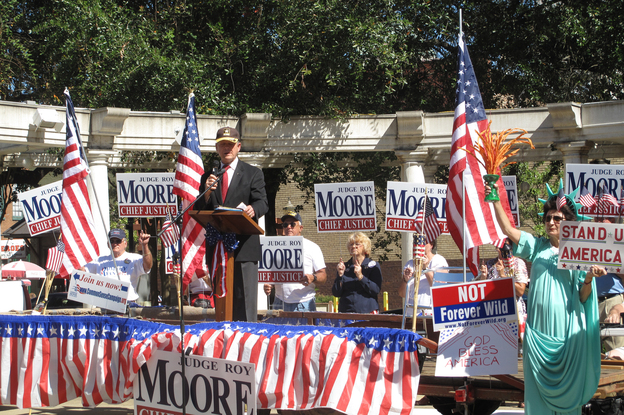
Former Alabama Chief Justice Roy Moore, known as the "Ten Commandments Judge," makes an appearance at a Tea Party rally in Mobile. The Republican is running for chief justice again despite being removed from the office nearly 10 years ago for defying a federal court order to remove a massive Ten Commandments monument from the Alabama judicial building.Republican Roy Moore, Alabama's controversial "Ten Commandments Judge," is back on the ballot this year, running for chief justice of the Alabama Supreme Court — despite being removed from that office nearly a decade ago.

15 Things Neither Romney Nor Obama Is Brave Enough to Stand For

Despite big differences, there are issues that neither candidate is brave enough to tackle.

10 States Where Voter Suppression Scams Target New Voters, Minorities and The Elderly

As the 2012 election countdown continues, voter scams are rising.

Meet 8 Romney-Backed Senate Candidates Who Would Force Victims to Have Their Rapists' Babies
Indiana's Richard Mourdock, who believes pregnancy caused by rape is a "gift from God," has plenty of company.

Chomsky: America Acts Like It Owns the World, While Endangering the Planet from Nuclear War and Climate Change

Inability to face the truth about ourselves in this country is all too common a feature across American society.

Do The Wealthiest People Have A Moral Responsibility To Pay Higher Taxes? Jerry Brown Says They Do

In an interview with The Financial Times, California Governor, Jerry Brown, said that he believes the wealthiest people in the state have a moral obligation to pay higher taxes. Proposition 30, championed by Brown, creates four high income tax brackets for taxable incomes in excess of $250,000, $300,000, $500,000 and $1,000,000.

Israeli Officials Warned Not to Comments on US-Iran Talks

The Israeli Foreign Ministry has sent a message to all embassies and consulates across the world, warning all Israeli officials not to publicly comment on the possibility of direct US-Iran negotiations. “We remind that the PM asked that all requests for interviews in the matter require his approval,” the message added at the end, underline the words “require his approval” for emphasis.
http://theuglytruth.wordpress.com/2012/10/26/israeli-officials-warned-not-to-comments-on-us-iran-talks/

Obama’s Battle for Ohio’s Atheist Vote

U.S. President Barack Obama’s multiple references to Planned Parenthood in the second presidential debate showed how keen he is to sway female voters in swing states. 

A new downturn in the global economy

There are increasing signs that the global economy is about to enter a new period of financial turbulence, coupled with deepening recession in a growing number of countries.

Catholic church to lose historic property tax exemption in Italy

The Basilica of St. Bartholomew, located on the island Isola Tiberina in Rome. (AFP Photo / Vincenzo Pinto)
Italy’s Catholic Church will be forced to pay taxes starting in 2013 after the EU pressured the country’s government to pass a controversial law stripping the Church of its historic property tax exemption. The Catholic Church in Italy is excluded from paying taxes on its land if at least a part of a Church property is used non-commercially – for instance, a chapel in a bed-and-breakfast.
http://rt.com/news/italy-church-tax-exemption-339/
PROOF: GOP Party Bosses Rigging Elections For Romney
The internet has been abuzz since the British website UK Progressive released a report on how a retired NSA analyst Michael Duniho had gone over the Arizona GOP Primary Results from earlier this year and discovered widespread GOP election fraud through what can be called an electronic fingerprint.

When Bosses Push Their Politics


Genetic Roulette (full movie)


The war against your food and health

Retired NSA Analyst Proves GOP Is Stealing Elections 

Saturday, July 14

What Happens When Atheists Confront Mortality


comments_image 6 COMMENTS


Two sets of researchers ask whether nonbelievers turn toward God after contemplating death.
 
Photo Credit: ShutterStock.com
 
 
LIKE THIS ARTICLE ?
Join our mailing list:

Sign up to stay up to date on the latest headlines via email.


Are there atheists in foxholes? That timeless question (the literal answer to which is yes) is a shorthand way of asking whether, when confronted by their own mortality, even nonbelievers’ thoughts turn to God.
Research published earlier this year tentatively concluded that they do. But a new study, conducted by scholars from three countries, reports that death-related thoughts lead us to reaffirm whatever belief system gives our lives meaning—and for atheists, that’s something other than religious faith.

Saturday, June 16

Does Religion Make Us Moral?


The scriptures of the world’s great religious traditions are chock-full of moral teachings. Believers are encouraged to treat each other as neighbors, to be kind to strangers, and to help the poor. But religious people aren’t always more moral or righteous than nonbelievers – indeed, religions have inspired wars, inquisitions, and seemingly endless prejudice. So is religion morally good or bad? Yale psychologist Paul Bloom thinks the answer is both. And the moral effects of religion stem from what religious people do together…not necessarily what they believe.
StealingPaul Bloom is a noted cognitive scientist whose work has focused on morality, the development of social abilities in children, and the evolution of religion. In 2005 he published a well-received article in The Atlantic that suggested that belief in God and other supernatural spirits was the accidental by-product of cognitive predispositions to see order and purpose in the world. Bloom asserts that people basically come hardwired to sense invisible presences and spirits in their environment. So he’s not exactly a raging Bible-thumper – in fact, he’s a self-described atheist.
It might seem surprising, then, that Bloom has recently published a paper in the Annual Review of Psychology detailing, in part, all the good that religion can do. Religion, Bloom points out, does actually seem to make people more altruistic and generous. Religious people give more to charities than non-religious people, including secular charities. And IRS tax receipts show that states where people are more religious have much higher rates of charitable giving than less religious states. Meanwhile, lab experiments show that participating in religious rituals primes people to be more generous and caring toward one another.
The benefits of religion don’t stop there. Actively religious people are much more likely to say they are “very happy” with their lives than their secular counterparts, according to a 2004 study cited by Bloom. And non-religious people are proportionately more like to express that they feel like failures.
But as always – at least when it comes to religion – the positives are balanced nearly evenly by the negatives, and this is Bloom’s point. For example, religious participation also often inspires people to be prejudiced against outsiders and minorities. In a 1950s study, the psychologist Gordon Allport showed that religious people were much more prejudiced against minority groups and foreigners than non-religious people. And in perhaps the most disconcerting study cited by Bloom, a research team recently found that exposing subjects to religiously themed words actually increased their levels of prejudice against African-Americans.
So is religion good for us or not? As an atheistic scientist, Bloom’s answer is a deliciously ambiguous “yes and no.” Religion, he believes, is simply a tool. It evolved to help humans solve the “free rider” problem of communal social life. When a social group depends on the efforts of all its members for success, free riders – people who accept help and resources from the group, but don’t give much back in return – can pose a serious threat to the entire collective. This threat is especially dire for human beings, since we depend almost entirely on our social abilities to survive.
According to Bloom, that’s where religion comes in. By demanding that people participate in costly, often painful rituals, religious groups ensure that their members have a strong motivation to stay involved and contribute economic and social resources to the group. It’s a bit like investing with friends – the more money you’ve put into the shared investment, the more motivated you are to make sure that investment pays off.
This evolutionary perspective on religion helps explain one of the most perplexing findings Bloom highlights: the moral effects of religion, both good and bad, are predicted by what sorts of religious behaviors people partake in, not whether or not they believe in God or an afterlife. In fact, private religious behaviors of all kinds don’t seem to make much difference when it comes to people’s ethical actions. For instance, among Palestinian Muslims attending mosque services often was associated with support of suicide bombings against Israelis, while individual prayer had no such association.
These findings back up a growing chorus of scholars in the religious studies world who insist that religion is essentially about action, not abstract beliefs and propositions. If Bloom is right, then participating regularly in group-oriented religious activities ought to make most people more generous, happy, and altruistic…as well as more suspicious of outsiders, prejudiced, and defensive of their in-groups. Like a cancer treatment with profoundly unpleasant side effects, religion inspires the best in human nature even while it trots out the worst.
But, Bloom points out, there’s reason to be optimistic. First, the association between religion and racial prejudice has declined – at least in America – since the mid-1960s. Secondly, Allport’s research also showed that only certain kinds of religiosity seemed to inspire prejudice. Religiosity that emphasized external rewards and social acceptance was associated with negative feelings toward members of other races, while religiousness that was focused on internal, subjective goals wasn’t.
The relationship between morality and religion is a difficult one. Calvinist Christian theologians like Karl Barth have argued that human morality has nothing to do with God’s sense of right and wrong, and that salvation can only come from God’s inscrutable decision. And, as other writers have pointed out, profound religious or mystical experiences often seem to blur the lines between good and evil, making the basic nature of the universe seem neither good nor bad. Meanwhile, figures such as the 16th-century Spanish nun Teresa of Avila make the opposite claim:
A single [religious experience] may be sufficient to abolish at a stroke certain imperfections of which the soul during its whole life had vainly tried to rid itself, and to leave it adorned with virtues and loaded with supernatural gifts. A single one of these intoxicating consolations may reward it for all the labors undergone in its life.
One thing is for sure: religions certainly play a major role in how people think about morality. In fact, religion undergirds such a vast portion of human society that it’s difficult to even imagine how we’d formulate our questions about ethics outside of religious frameworks. (Even modern secular cultures are still deeply informed by Christian language and themes.) Thorny questions like the relationship of religion and morality do accomplish one thing, though: they show that we need to understand religion if we want to understand ourselves, including our moral behavior. Bloom’s most important message, then, is not that religion is good, bad, or deluded. It’s that it would be, in Bloom’s words, “impossible to make sense of most of human existence, including law, morality, war, and culture, without some appreciation of religion and how it works.”

11
 
2
48
share
 

Monday, February 13

Moderate Religion is NOT Good for Societies

The Data Does Not Lie

[REPRINT]
Gregory S. Paul

Many a religious moderate and liberal are fuming. They are peeved because "mainline" religion is waning even more rapidly in America than is the religious right they believe is ruining organized supernaturalism, while atheism makes major gains as a segment of the population to the distress of theists in general (www.washingtonpost.com/blogs/guest-voices/post/atheism-on-the-upswing-in-america/2011/09/20/gIQAFch2hK_blog.html>www.washingtonpost.com/blogs/guest-voices/post/atheism-on-the-upswing-in-america/2011/09/20/gIQAFch2hK_blog.html). Theomoderates and liberals like Chris Hedges are further upset with how they are being disrespected by both religious fundamentalists from one end, and the "new" or more correctly assertive atheists from the other.

According to centrist religious supernaturalists whether Jewish, Christian, Muslim, Buddhist, Hindu or whatever, not only are they not the ones not responsible for the ills of modern societies, they are part of the levelheaded solution. In their opinion it seems eminently logical that the proposition that middle of the road moderate as well as liberal religion is more beneficial than either of the contentious extremes of fundamentalist theism on the one hand or assertive atheism on the other. Surely it is the common sense center that best understands how to run the societal show, not those extremist zealots on either side. Right?

And it is not just theists who subscribe to the notion that moderate faith being is fine. A number of nontheists go for it as well. Among them Chris Mooney who opposes serious criticism of center-left denominations and doctrines by the likes of Dawkins, Harris, Hitchens and myself. In this view it is the religious right alone that should be targeted by atheists, who should pander to the supernaturalist middle so they can be engaged as allies in the grand struggle with theoconservatism.

A godly advocate of the moderate religion is the best thesis is Johns Hopkins's William Egginton, who slanders assertive atheists as fundamentalists despite the term applying to theists who strictly adhere to their particular scriptures—it makes no more sense than does labeling antisupernaturalists who strongly oppose belief in ghosts and speaking to the dead as fundamentalists. But there is a funny thing about his recently published In Defense of Religious Moderation. It is anti-scientific. Looking through his thin book of opinions one is hard pressed to find data and analysis that actually supports the belief that supernaturalism is OK as long as it is not fundamentalist. It was a very big mistake.

Then again, no one else has actually tested the issue. Including me who should have known better. It is certainly possible to do so, their being sufficient evidence on hand (I published the basic stats in the below EP paper). If the temperate faith is good if not the best hypothesis holds up, then the larger the portion of the population that is moderately pious then the more successful the society should be. At the least conditions should not worsen the more theomods there are. Societies that are either more fundamentalist or atheist should be worse off. If the fundamentalists are right then the most theocon societies should be doing the best while more moderately religious and atheistic populations suffer. And if ungodly irreligion has the advantage then it alone should be associated with the best socioeconomic conditions while the two alternatives correlate with the opposite. So which of the alternatives is right?

It's a matter of statistics and analysis. And the results are not at all ambiguous. In my technical paper in Evolutionary Psychology (www.epjournal.net/filestore/EP07398441_c.pdf) I constructed the first and still the most comprehensive comparison of overall societal conditions in the prosperous democracies yet compiled, the Successful Societies Scale (see www.washingtonpost.com/blogs/guest-voices/post/is-religion-good-for-society/2011/10/17/gIQA9HutrL_blog.html for a less technical discussion). It is a compilation of about two dozen major indicators of societal and economic health, all scored and tallied up for each country on a 0-10 scale, with 0 being the very worst and 10 the very best.

Successful Societies Scale, Popular Religiosity-Secularism Scale

It has become fairly well known that the correlation between the SSS and overall religiosity in the EP paper shows a very strong trend in which less religious supernaturalism is associated with markedly better socioeconomic conditions. This is visually obvious in the plot, and is statistically confirmed by the Pearson correlation value of 0.705 that is so strong it qualifies as a statistician's dream. This is true because the most religious and Christian 1st world country, the US, scores below an embarrassingly low 3, so far down that its 1st world status is marginal. The most atheistic democracies score the highest, 7 and even an 8, with the religiously intermediate countries scoring between 4 and 7. One could hardly ask for a better real world result. The outcome means that no highly religious nation has ever been as successful as the most atheistic democracies, and as I explain in the EP paper there are core reasons why this will always be true.

That religion is a societal negative is no longer particularly controversial in sociological circles, it having been verified by a rapidly growing body of studies comparing both nations at large, and the situation within the US (gregspaul.webs.com/sciletter0415.pdf). This includes a new paper by Luke Galen in Mental Health, Religion and Culture that debunks the common wisdom that religious individuals tend to do better than their atheist counterparts. But what about different wings of religion? Do they produce different results as different theists claim?

In the EP paper levels of fundamentalist religiosity in 1st world countries were correlated with the SSS. Because fundamentalism is founded on strict acceptance of scripture as written I used Bible literalism as the basic measure of theoconservatism. The results showed that higher levels of fundamentalism are strongly associated with higher levels of socioeconomic dysfunction. This too can be seen visually in the plot, and is statistically verified by the strong correlation of -0.549. Within the US the most theocon regions tend to have the highest rates of dysfunction. This is not surprising for multiple reasons. Fundamentalism is both a reactionary response to modernity whose old style responses to societal problems (reliance on scriptures in which lethal violence is ordained by the god figure, violent punishment of children, rejection of gun control, opposition to comprehensive sex education) is combined with an embrace of the radical laissez-faire capitalism (opposition to universal health care and welfare, job insecurity and union bashing, plutocracy enhancing policies) that is the socially Darwinist recipe for degrading societal conditions for the majority—it is one of the great ironies of modern times that the theocons who denounce Darwinian science are the strongest advocates of Darwinian economics (www.opednews.com/articles/Can-We-Please-Stop-Pretend-by-Gregory-Paul-110830-388.html). At the same time, the superior societal conditions produced by the progressive secular policies the religious right loves to hate suppress the popularity of religion right as well as left.
Successful Societies Scale, Fundamentalists-Atheists

I also compared levels of popular atheism with the SSS in the EP paper. If Egginton et al. are correct about the "extremes" being similarly bad, then the more atheism there is in a nation then the worse off the citizens should be, as they are with more fundamentalism. But the data shows the opposite. More atheism is strongly correlated with better conditions, the Pearson correlation of 0.547 soundly verifying the atheist advantage.

It did not occur to yours truly to see how moderate religion performs in the EP study. That was an oversight. When I noted that Egginton's views are not scientific on a Baltimore radio program he continued to contend that moderate religion is a societal positive but failed to back up the claim. Instead he made a vague assertion that societal conditions are improving in the US, which although generally true does not mean that religious moderation is behind the change for the better. I then realized no one had run the statistics, and became most curious what they would reveal. To arrive at the number of moderates as well as liberals I subtracted the Bible literalists from the total religious in each nation examined—as you can see in the plot the US has among the largest portion of religious moderates, something that does not portend well for the religious moderation hypotheses. Before I began the analysis I was pretty confident that moderate faith would not correlate with superior circumstances, but I vaguely imagined it would not be all that bad either.
That's why it is always important to run the stats to see what is actually going down.

What should give the religion in moderation is preferable to either fundamentalism or atheism crowd a sharp sociological whack upside their collective heads is that more moderate to liberal religion not only does not correlate with better conditions, nor is it even neutral, but it too strongly correlates with inferior conditions, the Pearson correlation being -0.566. Middle of the road religion is actually about as strongly associated with adverse circumstances as is theoconservatism. Praise be to scientific statistical analysis for uncovering the cold quantitative truth.

Successful Societies Scale, Moderate-Liberal Theists

The same general pattern applies over time. Many indicators of societal dysfunction have indeed been getting better over the few decades, a major exception being a shorting of lifespans in parts of the Bible Belt. Over the same period of time atheism has been on the rise as religious activities including the more moderate expressions have withered. Longitudinal evidence that moderate faith is helping make things better is at best scarce.

Surprised? After all, theomods and theolibs favor the modern progressive policies that make societies better. But the results are in accord with the phenomenon of unintended consequences, one in which theists who help enact effective secular policies do not realize that the improving conditions that result cannot help but depress the kind of religiosity they prefer. If anything moderate denominations have proven more vulnerable to decline in the face of modernity than the more ardently reactionary theocons, which may explain why the negative correlation with superior conditions is stronger for the middle of the roaders than the right wingers. This too is supported by the stats—the Pearson correlation between higher national income disparity and more moderate religiosity is a really strong 0.726, higher than the still impressive 0.666 for fundamentalism.

So Egginton and company are just plain wrong. Even though religious moderation is not societally toxic the way theoconservatism is, it cannot survive the onset of secure prosperity that is invariably toxic to mass religious supernaturalism. No matter what its flavor, religion can never be the solution the way that democratic atheism can and is.

I will now predict how the theomods and libs will respond to the presentation of the evidence. Very few will admit they are wrong and become atheists. I say few because some that will get the reality of the situation and change their minds thereby joining the atheist groundswell. But most will not get it. They will attempt to construct new, denial based justifications for why it is OK for societies to be theistically centrist. Specifically, they will contend that since it has not been shown that theomoderation and theoliberalism are direct contributors to the grave problems of society, there is nothing wrong with the majority remaining pious as long as they are reasonable about it. These good folks will really, really, miss the point. Showing the center-left religion is not as bad as the conservative variety is like showing that living in Brazil is better than living in Somalia—true, but so what when there are Swedens and Germanys. And even more to the point, whether or not faith-based moderation is good or bad is irrelevant when the best socioeconomic circumstances kill off the faith. It just won't work. The fact is that in much of the west strong majorities no longer ask what would Jesus do, or pay much mind to any religion, and they are doing more than just fine thank you. You cannot run a civilization without language. Nor without the materialism that is the reason civilizations exists in the first place. But you can run a civilization without religion. And because the best run societies are the most atheistic, that means the best way to make cultures more atheistic is by running them as well as possible (see minutes 41:00-48:00 & 54:00-57:00 in richarddawkins.net/article,4561,Why-Evolution-Is-True,Jerry-Coyne-AAI-2009-RDFRS-Josh-Timonenwhyevolutionistrue.wordpress.com/2011/04/26/greg-paul-the-science-of-religion-2.) There is no pressing need for any supernaturalism no matter how sensible its adherents may claim it is.

Far from the ungodly extreme creating problems like the fundamentalist extreme, the denial of the gods alone has produced the goods. It follows that only advocates of atheism have the national statistics to back up their position. That means that theists conservative to liberal must put up or shut up. Moderate supernaturalists who proclaim their proscience worldview while denouncing the fundamentalists' superstitious rejection of intellectual modernity should be especially willing to produce the sociological beef before continuing to propound upon their currently speculative opinions. The Eggintons and Hedges have to show us an example of a highly religious nation that is doing as well in the major social indicators as the most atheist democracies. Or how about a 1st world country where overall conditions are improving as temperate religion rises? Then you have a case to discuss. If you can't—and you can't—then you are operating all too near the level of the fundamentalists you decry for their obtuse antiscientism (I have been challenging those who think religion is a societal positive to publish comprehensive technical studies to that effect since my first paper on the issue in 2005, Moses.creighton.edu/JRS/2005/2005-11.pdf, so far nothing has shown up and I am not holding my sociological breath). Continuing to make assertions in the face of contradictory data is irresponsible unless convincing countervailing evidence is produced.

It is not the assertive atheists who are acting like fundamentalists because we have the data on our side. It is the pious moderates who denounce assertive atheists as fundamentalists, despite the absence of the scriptures that fundamentalism rests upon, who are acting like fundamentalists by brushing aside inconvenient scientific facts. And this is one reason why assertive atheists are so critical of the theological moderates. The refusal of atheists to accept the unsubstantiated opinion that moderate religion is the best or even a viable societal option is not some sort of fundamentalist obstinacy, it is the only logical scientific conclusion. Nor is it any more or less extreme that denying the reality of ghosts of the geocentric theory. So why should atheists buy into the myth of supernaturalistic moderation? Seriously, you folks don't have anything to back up your claims, so why are you beating the dead horse of centrist superstition?


Interested in publishing on the Secular Web? See the Submission Guidelines & Instructions.

Disclaimer: Kiosk articles represent the viewpoint of their authors and should not be taken as necessarily representative of the viewpoint of Internet Infidels and/or the Secular Web. Full disclaimer here.

Copyright 2012, Internet Infidels, Inc. Copyright info here.
Published: 2/7/2012
Categories:
Secularism

Wednesday, July 27

Do People Follow the Ten Commandments? Behavior and Beliefs Often Don't Match

Do People Follow the Ten Commandments?
Behavior and Beliefs Often Don't Match


By Austin Cline, About.com Guide
[REPRINT]

There are lots of debates over the cultural and political status of the Ten Commandments, but in all of those debates there is a common assumption that devout religious people are already following them and everyone else should start. Is it true, however, that religious people currently follow the Ten Commandments with any degree of consistency?

Jews presumably do a fair job at trying to follow their Decalogue, but it’s Christians — and conservative evangelicals in particular — who do the most to promote these laws in civil society, so perhaps we should focus on them. When we do, we find something interesting: not only do they not consistently follow the commandments, but in fact a couple are broken so regularly and casually that it doesn’t even appear as though anyone really tries.

The second commandment, at least according to Protestants, is a prohibition against “any graven image, or any likeness of any thing.“ The more literally one reads this, the more that would have to be forbidden: crosses, crucifixes, statues of Jesus, status of saints, icons of any sort, even photographs and realistic paintings. Muslims adhere to such a rule strictly, and as a consequence, artistic decoration consists of abstract design rather than the human figures that one typically sees in many churches.

Most Christians today, if they accept this commandment at all (it’s not included on Catholic lists), don’t interpret it literally. At most they read it to mean that one shouldn’t make any idols designed to represent God (although statues of Jesus, who is also God, are somehow exempt from even this most mildest of readings). Once we allow this commandment to be interpreted mildly or metaphorically, however, what’s to stop us from doing the same with the others? Should the commands not to kill or steal be read metaphorically?

Even more significant is the breaking of the Sabbath. The Ten Commandments require that people work for six days and then rest on the seventh, which is Saturday. This is what Jews and some small Christian groups do. Almost all contemporary Christian denominations have placed their sabbath on a Sunday, however, which is the first day of the week.

This might not seem like such a huge issue — after all, Christians are still working six days and resting one, which is one of the points of this commandment. Another point of the commandment, however, is to commemorate God who worked six days and rested on the seventh; Christians who don’t rest on the final day of the week are quite simply getting things backwards. God certainly didn’t start off the grand task of creating the universe by taking a coffee break.

Furthermore, Christians today don’t adhere to the prohibition on working as strictly as orthodox Jews. Christian may go to church services and they may not go to the office, but that doesn’t mean that they don’t work. On the contrary, most do quite a bit of work on their sabbath: yard work, house work, school work, etc. Very few Christians actually refrain from any work whatsoever, and I doubt that you will find many who go to the same lengths as orthodox Jews who refuse to drive, turn on lights, light stoves, etc.

Suggested Reading

* Ten Commandments: Introduction
* Ten Commandments: Analysis
* Ten Commandments: Different Versions
Related Posts Plugin for WordPress, Blogger...