American Politics, Progressive News, Human Rights, Civil Disobedience, Foreign Policy, Current Events, Cultural Activism, and Social Justice.
http://www.dustcircle.com | http://www.facebook.com/dissentingheretic | http://www.twitter.com/dustcirclenews
Showing posts with label new york city. Show all posts

Friday, November 2

02.Nov.2012 - Demonic Possession, New York Crises, Climate Change Gridlock, High School Atheist Club, New World Order, Capitalist Dictatorship, Next President of Austerity, Small Markets Big Money, Vote the Bible Shirts, Fighting Monsanto, We Are Not Powerless

Congratulations to Eric Fox of Colorado for winning the Free Book, The End of Faith by Sam Harris! 
December, we will be giving away another book! Stay tuned for details! There is no catch besides getting involved. 
Stay informed. Immerse yourself. Everything affects you and your loved ones. 
To donate to The Dissenting Heretic, use the WE PAY button on our website: http://www.Dustcircle.com

Shocking Poll - More than Two-Thirds of Republican Voters Believe in Demonic Possession

And less than half think humans are responsible for climate change.

1 Not-So-Simple, Pretty Funny Question for the 73% of White Evangelicals Who Will Apparently Be Voting for Romney

A question that deserves an answer before election day.


Residents of New York Face a Huge Range of Crises

Contradictions abound in NYC -- huge swathes of the city are fine, while entire neighborhoods are facing serious shortages.

Climate Change Gridlock: Where Do We Go From Here? (Part 1)
Global warming is no longer a fear for the future, it’s threatening human civilization now. But a good portion of humanity doesn’t seem that concerned. On this edition, part 1 of a special 2 part series, Brian Edwards-Tiekert takes us through the climate change that is happening, the political response that isn’t, and the people trying to break the gridlock.

article imageStudent Duncan Henderson Fights for Two Years to Start Atheist Club at Alabama High School

Student Duncan Henderson has been trying to start an atheist club, called the “freethinker” club, at Auburn Junior High in Auburn, Alabama, but was met with strong resistance for two years.
(spelling corrected here^)

From Chaos To A New World Order: Words Of Hope At The United Nations
Existing political/economic structures that serve not the people are in decay, a new world order based on universal principles of goodness: justice, equality, unity and freedom Is the call of many around the world.

Capitalist Dictatorship in Romney Campaign
he mainstream media and even Democrats have been slow to call Mitt Romney's deliberate falsehoods "lies." But after just calling them what they are, it is also important to analyze their meaning. Lies on Romney's scale do not simply show contempt for the intelligence of American voters. They show contempt for democracy, and display some of the features of capitalist dictatorship of a sort that was common in the late twentieth century. 

The Source of Romney’s Lying

Exclusive: An enduring mystery about Mitt Romney is why he lies so persistently and with so little shame. Some people blame his business experience or cite the basic dishonesty of politics, but there is also the curious foundation of his Mormon religion which was started by a proven conman, notes Robert Parry.

Telling Truths about Israel/Palestine

False national narratives play key roles in controlling human behavior, especially when enforced by an aggressive propaganda system that demonizes factual counter-narratives. That has long been the case as Israel minimized its harsh treatment of Palestinians, but the truth has begun to break through, says Lawrence Davidson.
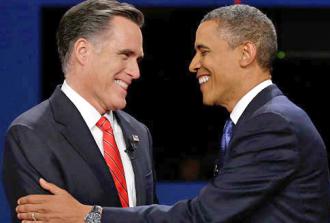
Mitt Romney and Barack Obama meet at their second debate
The next president of austerity
We know from history that the "lesser evil" is no guarantee against the "greater evil."
http://socialistworker.org/2012/11/01/the-next-president-of-austerity

Small markets, big money
The sports media is moaning about the trade of Oklahoma City Thunder star James Harden to the Houston Rockets--but NBA owners are making out just fine.
http://socialistworker.org/2012/11/01/small-markets-big-money

WHY DO WE NEED A PRESIDENT ANYWAY?

It wasn’t always a given that we’d have a single executive who has the power to make final decisions about the fate of our country.


Christian group fights Texas for banning ‘Vote the Bible’ shirt at polls
"Vote the Bible" shirt banned at Texas polling placesA Christian group in Texas is threatening to file a formal complaint with the Attorney General’s office because a woman who lives near Austin was forced to cover up her “Vote the Bible” T-shirt after election officials suggested that it could be construed as illegal electioneering.
http://www.rawstory.com/rs/2012/11/01/christian-group-fights-texas-for-banning-vote-the-bible-shirt-at-polls


A Grim Warning from Science

One of the things that makes Sandy different from Katrina is that it’s a relatively clean story. The lessons of Katrina were numerous and painful—they had to do with race, with class, with the willful incompetence of a government that had put a professional Arabian horse fancier in charge of its rescue efforts.

Corporate Media Breaks Climate Silence, Following Undeniable Sandy Superstorm

As many have now observed, part of the new reality in Sandy's aftermath—whether too slowly, reluctantly or imperfectly—is that many mainstream media outlets, once decidedly resigned to avoid the scientific consensus, are now asking significant questions about the role of human-induced global warming and the impact of climate change and extreme weather.

Hurricane Sandy and the Myth of the Big Government-vs.-Small-Government Debate

Quite a shock the other day to look out my window in Jersey City, and see the Hudson River rushing over what used to be the street in front of my building. For nearly three days my dog and I played Robinson Crusoe and Friday, sleepily watching from our little apartment-island while we waited for hot water, cell service, the internet, even elevators to come back on line.

Why Monsanto Is Fighting Tooth and Nail Against California's Prop 37

A new poll conducted by the University of Southern California and the LA Times has found that Proposition 37, the GMO labeling initiative has slipped a whopping 17 points since the last poll in September. The proposition continues to lead but only by 2 percentage points with less than a week before the election. Thirteen percent of likely voters are still undecided on whether to require mandatory labeling of genetically modified organisms in foods.

We Are Not Powerless to Confront Climate Change

Millions of victims of Superstorm Sandy remain without power, but they are not powerless to do something about climate change. The media consistently fail to make the link between extreme weather and global warming. Through this catastrophe, people are increasingly realizing that our climate has changed, and the consequences are dire.

Senate likely to revisit cyber bill when Congress returns

Senator Joe Lieberman, one of the authors of the bill, would consider dropping a provision aimed at shoring up protection of critical infrastructure that had raised concerns among Senate Republicans, if that issue could be addressed in an executive order, Jeffrey Ratner, senior adviser for cybersecurity on the Senate Homeland Security Committee, said Wednesday.

Looking Beyond Election Day: The Issues That Threaten to Derail the Nation

What follows is an overview of the major issues that both Barack Obama and Mitt Romney, despite their respective billion dollar war chests, have failed to mention during their extensive campaign trail stumping and televised debates. These are issues that aren't going away anytime soon. Indeed, unless we take a proactive approach to the problems that loom large before us, especially as they relate to America's ongoing transformation into a police state, we may find that they are here to stay.

Sandy Forces Climate Change on US Election
A dead deer lies among driftwood and debris left by a combination of storm surge from Hurricane Sandy and high tide in Southampton, New York, on October 30, 2012. (photo: Lucas Jackson/Reuters)The presidential candidates avoided the topic at all their big public forums - except for Romney's Republican national convention joke about how silly it was to try and slow the rise of the oceans (which probably didn't win him many votes on the Jersey Shore this week). Obama did talk climate with MTV last week, but that venue almost defines the issue's fringe status; his other real discussion of it was with Rolling Stone - global warming is, apparently, only for people with earbuds.

Two diametrically opposed views on the #Occupy movement

Two wildly different takes on the Occupy movement have recently found their way into my Twitter feed. Both deserve careful consideration (watch this blogspace):

When will male politicians take women's rights seriously?
Feminism appears to be back with a vengeance in the UK. Kirsty Styles reports from the UK Feminista lobby of Parliament, and asks how long it will take before the f-word that really rings true in our society is 'fairness'

'Letting taxpayers fund parties directly could revive our rotten system.' (photo: Donkey Hony)When Corporations Bankroll Politics, We All Pay The Price
t's a revolting spectacle: the two presidential candidates engaged in a frantic and demeaning scramble for money. By 6 November, Barack Obama and Mitt Romney will each have raised more than $1bn. Other groups have already spent a further billion. Every election costs more than the one before; every election, as a result, drags the United States deeper into cronyism and corruption. Whichever candidate takes the most votes, it's the money that wins.

Why the Protestant Work Ethic Is a Menace to Society

Good riddance to a religious approach that preached salvation through constant hard labor.

The 9 Most Anti-Science Candidates in America
These House and Senate candidates don't like that book learnin'.

How Christian Fundamentalism Feeds the Toxic Partisanship of US Politics

When evangelicals attack 'the gay agenda' of an anti-bullying event in schools, something is sick in America's religious culture


Distrust growing among voters in California


US military spending in question


US-Israel conduct Largest Military Drill to date


The Depression Cure That Society Won't Allow


More 'Once in a Lifetime' Weather Events Likely


A Crisis Foretold: Studies Warned New York Infrastructure Critically Threatened by Climate Change


Without Power and Aid, Low-Income Residents of NYC’s Lower East Side Struggle in Storm’s Aftermath


David Rohde: Superstorm Sandy Has Exposed New York City’s "Hideous Inequality"


As Missouri Senate Race Tightens, New Details Emerge on Todd Akin’s Anti-Abortion Past

Tuesday, October 30

30.Oct.2012 - Hurricane Sandy Articles and Videos, + 1 More day to win the FREE book! (plus many other articles+videos)

The Dissenting Heretic is a FREE service. If you enjoy and support what we do here, please consider donating via https://www.wepay.com/donations/the-dissenting-heretic - It helps offset our daily time put in, and website maintenance fees. Thank you! - Steve


This month, we are giving away a FREE copy of The End of Faith by Sam Harris. Simply go to our Facebook page, and start sharing our posts. The person or organization that shares the most DH posts by Halloween wins the book!  
 
You are viewing this from http://www.dustcircle.comAlso, follow us on Twitter and Facebook for exclusive content.

Frightening and Amazing Photos From Those Enduring Sandy's Wrath

Sometimes you just have to see it to believe it.

6 Top Economists Explain Which President Is More Likely to Speed the Next Financial Crisis
Five out of six say Romney is a worse bet on crisis-avoidance. But Obama has big challenges to address if re-elected.

Does TV Help Make Americans Passive and Accepting of Authority?

There is evidence that the mere act of watching TV -- regardless of the content -- may well have a primary pacifying effect.

Documents Found in Meth House Show the Inner Workings of a Dark Money Group Linked to 23 Conservative Candidates
The documents offer a rare glimpse into the world of dark money, showing how Western Tradition Partnership appealed to donors, interacted with candidates and helped shape their election efforts.

US election: what can Latin America expect?

Relations between the US and Latin American countries have always been tense, from economic rivalry to political assassinations. During his first term, Barack Obama has failed to build bridges between the Americas - what can peoples from Latin America and the Caribbean expect from the next president?

US third party debate presents no alternative for working class
Four candidates met in Chicago last Tuesday for what was billed as the first Third Party Presidential Debate. The event was moderated by former CNN host Larry King and Christina Tobin, founder and chair of the Free and Equal Elections Foundation. It was streamed live online at Ora.tv and also broadcast by CSPAN.

One week to Election Day in America: The real choice for workers
The American population is presented with a “choice” between two multi-millionaires. One, the Republican candidate Mitt Romney, personifies the financial speculators whose criminality and greed triggered the financial crisis that erupted in 2008. The other, President Obama, has devoted his entire administration to protecting and expanding the wealth of the financial elite, destroying the democratic rights of the American people, and escalating military aggression internationally.

Supreme Court Will Decide If You Actually Own What You've Bought

Copyright holders keep trying to downplay the "horror story" scenarios that many of us worried about a ruling in favor of Wiley could lead to. However, if the Supreme Court says that it's copyright infringement to sell a copyright-covered work made outside the US, but legally imported in, you can bet that all sorts of companies will seek to take advantage of this fact. 

Washington Post: Yes, We Need To Give Up Liberty For Security

By now you've probably seen the paraphrase of a Ben Franklin quote that those who give up liberty for security, deserve neither (he said similar things a few different ways, but the standard actual quote is: "Those who would give up Essential Liberty to purchase a little Temporary Safety, deserve neither Liberty nor Safety.") Whatever the actual quote is, there is quite a lot of truth to it. Giving up liberty for the sake of security rarely works out as planned. Either way, it appears that the editorial board of the Washington Post is either wholly unfamiliar with the quote, or believes it to be untrue. It has come out with an editorial arguing in favor of extending the FISA Amendments Act (and against an ACLU/EFF challenge to the law, to be heard today at the Supreme Court, even with the crazy weather) saying that it is perfectly fine to "give up liberty" for security

FBI Releases 2011 Crime Statistics
According to the figures released today by the FBI, the estimated number of violent crimes in 2011 declined for the fifth consecutive year. Property crimes also decreased, marking the ninth straight year that the collective estimates for these offenses declined. The 2011 statistics show that the estimated volumes of violent and property crimes declined 3.8 percent and 0.5 percent, respectively, when compared with the 2010 estimates. The violent crime rate for the year was 386.3 offenses per 100,000 inhabitants (a 4.5 percent decrease from the 2010 rate), and the property crime rate was 2,908.7 offenses per 100,000 persons (a 1.3 percent decrease from the 2010 figure).
Hurricane Sandy: Opportunity for Obama to show steady leadership
Sandy anticipated to be worse than KatrinaPresident George W Bush was criticized for his ineffective handling of Hurricane Katrina, which left the Louisiana city of New Orleans so severely devastated by wind and water, that it still has not fully recovered. Hurricane Sandy is predicted to be far worse and is anticipated to hit land in the Eastern parts of the United States on Monday night.
A Hostile Takeover of Our Country
merican democracy is under assault. In one super-PAC alone, Karl Rove and the Enron grifter Ed Gillespie, have assembled $200 million from big polluters and Wall Street moguls to buy the 2012 election.http://readersupportednews.org/opinion2/277-75/14252-a-hostile-takeover-of-our-country

Mitt Romney and President Obama at the first presidential debate of 2012. (photo: Reuters/Jim Bourg/AP/Eric Gay)
How Big Can One Election Get?
besity is an American plague - and no, I'm not talking about overweight Americans. I'm talking about our overweight, supersized presidential campaign. I'm talking about Big Election, the thing that's moved into our homes and, especially if you live in a "swing state", is now hogging your television almost 24/7.

How Christian Fundamentalism Feeds the Toxic Partisanship of US Politics
ix It Up at Lunch Day is one of those programs that just seems like a nice thing to do.

Just Label It: Let the People Decide
90 percent of citizens support mandatory labeling for genetically engineered foods. (photo: Friends Eat)'ve farmed all my life and I have to tell you, all food is not the same. No food or farming system is perfect, but as farmers, as citizens, we should not be forced to accept a globalized, industrialized, genetically modified system of agricultural production.

Medicaid on the Ballot

There's a lot we don't know about what Mitt Romney would do if he won. He refuses to say which tax loopholes he would close to make up for $5 trillion in tax cuts; his economic "plan" is an empty shell.

Romney Avoids Taxes via Loophole Cutting Mormon Donations
Romney Avoids Taxes Exploiting Loophole Reducing Donation The charitable remainder unitrust, as it is known, is one of several strategies Romney has adopted over his career to reduce his tax bill. While Romney’s tax avoidance is legal and common among high-net-worth individuals, it has become an issue in the campaign. President Barack Obama attacked him in their second debate for paying “lower tax rates than somebody who makes a lot less.” In this instance, Romney used the tax-exempt status of a charity -- the Mormon Church, according to a 2007 filing -- to defer taxes for more than 15 years.
http://www.bloomberg.com/news/2012-10-29/romney-avoids-taxes-via-loophole-cutting-mormon-donations.html
How US Drones Forge as Many Foes as They Kill
World View: The enhanced use of unmanned attack planes is at the heart of American foreign policy

Our Words Are Our Weapons Against the Destruction of the World by Greed
In ancient China, the arrival of a new dynasty was accompanied by “the rectification of names,” a ceremony in which the sloppiness and erosion of meaning that had taken place under the previous dynasty were cleared up and language and its subjects correlated again. It was like a debt jubilee, only for meaning rather than money.

Israeli Jets Bomb Sudan "Missile Site" in Dry Run for Iran attack
Click to enlarge
Click to enlarge

Why I’m Voting Green
Those who rebel are our only hope

10 Filthy-Rich, Tax-Dodging Hypocrites Pushing Disastrous Austerity on America

MonopolyThe Fix the Debt coalition is using the so-called "fiscal cliff" to push the same old corporate agenda of more tax breaks while shifting the burden on to the rest of us.


Watching Sandy, Ignoring Climate Change

A couple of weeks ago, Munich Re, one of the world’s largest reinsurance firms, issued a study titled “Severe Weather in North America.” According to the press release that accompanied the report, “Nowhere in the world is the rising number of natural catastrophes more evident than in North America.” The number of what Munich Re refers to as “weather-related loss events,” and what the rest of us would probably call weather-related disasters, has quintupled over the last three decades. While many factors have contributed to this trend, including an increase in the number of people living in flood-prone areas, the report identified global warming as one of the major culprits: “Climate change particularly affects formation of heat-waves, droughts, intense precipitation events, and in the long run most probably also tropical cyclone intensity.”

Why Elections Matter—and Why We're Still Arguing About It

It’s practically the eve of the election—and I’m still kind of stunned to hear from people who don’t plan to vote, who think voting doesn’t matter. A young writer, 21 years old, wrote to me the other day, after seeing an interview I did on what elections are and aren’t, and on how the candidates do and don’t differ on foreign policy. (Spoiler alert: mostly they don’t.)

Iraq, Libya and 9/11
Jailed for telling the truth

Hurricane Sandy and Climate Change: "If There Was Ever a Wake-up Call, This Is It"


Pentagon is World’s Leading Landlord


Campaign Rhetoric Vs. Reality Checks


What is Global and What is Local?


New York under water: Mayor addresses flooded city


Are horrific storms like Sandy the new norm? A look at the science behind extreme weather


Wednesday, March 28

Occupy May Day:

Occupy Wall Street is gearing up for a new kind of general strike on May 1st. (photo: Jed Brandt)

Not Your Usual General Strike

By Jeremy Brecher, Common Dreams


ast December, Occupy Los Angeles proposed a General Strike on May 1 "for migrant rights, jobs for all, a moratorium on foreclosures, and peace - and to recognize housing, education and health care as human rights." The idea has spread through the Occupy movement. Occupy Wall Street in New York recently expressed solidarity with the proposal and called for "a day without the 99%, general strike, and more!" with "no work, no school, no housework, no shopping, take the streets!" Reactions are ranging from enthusiastic support to outraged skepticism. What form might such an action take, and what if anything might it achieve?

Occupy Wall Street: Take the Bull by the HornsGeneral Strikes and Mass Strikes

One thing is for sure: Such a May Day action is unlikely to be very much like the general strikes that have cropped up occasionally in US labor history in cities like Seattle, Oakland, and Stamford, Ct., or the ones that are a staple of political protest in Europe. These are typically conducted by unions whose action is called for and coordinated by central labor councils or national labor federations. But barely twelve percent of American workers are even members of unions, and American unions and their leaders risk management reprisals and even criminal charges for simply endorsing such a strike.

Most Occupy May Day advocates understand that a conventional general strike is not in the cards. What they are advocating instead is a day in which members of the "99%" take whatever actions they can to withdraw from participation in the normal workings of the economic system - by not working if that is an option, but also by not shopping, not banking, and not engaging in other "normal" everyday activities, and by joining demonstrations, marches, disruptions, occupations, and other mass actions.

This is the pattern that was followed by the Oakland General Strike last November. Those who wanted to and could - a small minority - didn't go to work. There was mass participation in rallies, marches, educational, and artistic events and a free lunch for all. At the end of the day a march, combined with some walkouts, closed the Port of Oakland. The mostly peaceful "general strike," in contrast to later violent Oakland confrontations, won wide participation and support.

To understand what the significance of such an event might be, it helps to look at what Rosa Luxemburg called periods of "mass strike." These were not single events, but rather whole periods of intensified class conflict in which working people began to see and act on their common interests through a great variety of activities, including strikes, general strikes, occupations, and militant confrontations.

Such periods of mass strike have occurred repeatedly in US labor history. For example:

In 1877, in the midst of deep depression and a near-obliteration of trade unions, workers shut down the country's dominant industry, the railroads, shut down most factories in dozens of cities, battled police and state militias, and only were suppressed when the US Army and other armed forces killed more than a hundred participants and onlookers.

In the two years from 1884 to 1886, workers swelled the Knights of Labor ten-fold from 70,000 members to 700,000 members. In 1886, more than half-a-million workers in scores of cities joined a May 1st strike for the eight-hour day. The movement was broken by a reign of terror that followed a police attack that is usually but perversely referred to as the "Haymarket Riot." May Day became a global labor holiday in honor of the "Haymarket Martyrs" who were tried by a judge so prejudiced against them that their execution has often been referred to as "judicial murder."

In 1937, hundreds of thousands of workers occupied their factories and other workplaces in "sitdown strikes" and housewives, students, and many other people applied the same tactic to address their own grievances.

In 1970, in the midst of national upheavals around the Vietnam war, the civil rights movement, and a widespread youth revolt, postal workers, teamsters, and others took part in an unprecedented wave of wildcat strikes, while miners held a month-long political strike in West Virginia to successfully demand justice for victims of black lung disease.

Such periods of mass strike present what Rosa Luxemburg called "A perpetually moving and changing sea of phenomena." Each is unique in its events and its unfolding. But they are all marked by an expanding challenge to established authority, a widening solidarity among different groups of working people, and a growing assertion by workers of control over their own activity.

In periods of mass strike working people become increasingly aware of themselves as a group with a common situation, common problems, and common opponents. They organize themselves in a great variety of ways. They become aware of their capacity to act collectively. They become aware of their potential power. And they opt to act collectively.

However much it may chagrin organizers and radicals, it is not possible to call or instigate a mass strike. It is something that must gestate in workplaces and communities (now including virtual communities). But it is possible to nurture and influence the emergence of mass strikes through discussion and above all through exemplary action. Provoking discussion and showing the possibilities of collective action is what Occupy Wall Street has done so well. That is what its May Day action can potentially do.

What Occupy May Day Could Achieve

The Occupy May Day event is first of all a great chance for 99% to show itself, see itself, and express itself - to represent itself to itself and to others. The kinds of plans that are being made by OWS in New York, with a wide variety of ways in which people are being invited to participate, can encourage multiple levels of sympathy, response, connection, and mobilization among the 99%. The result can be a percolation of the ideas OWS has been promoting through workplaces, communities, and other milieus.

May Day can provide a teachable moment. It is an opportunity for millions of people to contemplate the power that arises from collectively withdrawing cooperation and consent. It can propagate the idea of self-organization, for example through general assemblies. If it truly draws together a wide range of working people, ranging from the most impoverished to professionals, from urban to suburban to rural, and including African Americans, Latinos, whites, and immigrants, it can embody the ability of the 99% to act as a group. It can demonstrate the idea of solidarity, for example by the movement as a whole supporting the needs of some particular groups. And because May Day is a global working class holiday which will be celebrated all over the world, it can reveal a rarely seen vision of a global working class of which we are as individuals and as members of diverse groups are part.

Given these possibilities, what would constitute success for May Day? Here are some examples of desirable outcomes:

Reveal that there is a 99% movement that is far wider than the subset of its members who can confront the police and sleep in downtown parks.

Encourage a large number of people who have not done so before to identify with and participate in some way with the "99% movement."

Project core issues of the 99% - like the list above from Occupy LA -into the pubic arena.

Raise issues that are crucial for the future of the 99% - notably the climate crisis and the destruction of the Earth's environment - that have not yet been recognized as part of the Occupy critique of financial institutions and corporate capitalism.

Evoke self-organization in workplaces, for example general assemblies among workmates, on the job if possible, in the parking lot or another venue if not.

Create a self-awareness of the global 99% - possible because May Day is celebrated globally.

Unions and May Day

American unions are bound by laws specifically designed to prevent them from taking part in strikes about issues outside their own workplace, such as sympathetic strikes and political strikes. In most cases they are also banned from participating in strikes while they have a contract. Unions that violate these prohibitions are subject to crushing fines and loss of bargaining rights. Their leaders can be packed off to jail. While unions have at times struck anyway, they are unlikely to do so for something like the May Day general strike until the level of class conflict has risen so high that workers are willing to face such consequences.

Historically, American unions have also opposed their members' participation in strikes union officials have not authorized because they wished to exercise a monopoly of authority over their members' collective action. In labor movement parlance, such unauthorized actions were condemned as "dual unionism." US unions have often disciplined and sometimes supported the firing and blacklisting of workers who struck without official authorization. As a result, unions have often deterred their members from participating in mass strike actions even when the rank and file wanted to.

The Occupy movement, however, should not be seen as a competitor to existing unions. It is not about relations between a group of workers and their employer. It does not engage or wish to engage in collective bargaining. Although it supports the right of workers to organize themselves, it is not a union. It focuses on broader social issues. It is a class movement of the 99%, not a labor or trade union movement.

Unions in New York and elsewhere are eager to participate in coalition actions with the Occupy movement - and they are planning to do so on May Day. But to ask them to instruct their members to strike may be to ask them to commit institutional suicide.

One approach to this dilemma may be for unions to say they will abide by the law and not order their members to strike, but that as human beings and as people living under the US Constitution their members are not slaves and cannot be compelled to work against their will. Where union members want to participate in May Day by not going to work, unions can say, we did not tell them to strike, but we do not have the right to force anyone to work against their will. A historical precedent: When Illinois miners repeatedly went on extended wildcat strikes and Mineworker leader Alexander Howat was commanded to order them back to work, he would simply reply that since he had not ordered the strikers out, he could not order them back.

Organized labor has to change, and activities like Occupy's May Day can contribute to that change. But they can do so at this point not by making impossible demands on union leaders but by inspiration, example, solidarity, and providing alternative experiences for union members.

Global Mass Strike

We are today in the midst of an unrecognized global mass strike - witness the mass upheavals reported in the news almost daily from countries around the world. Wisconsin and Occupy Wall Street represent the first stirrings of American workers to join this global movement. May Day 2012 will be a global event, and it presents an opportunity to create a new self-awareness of the global 99% and its ability to act collectively.

While the Occupy movement has focused on the issues of economic injustice, it is increasingly addressing another issue that is central to the well being of the 99% - indeed of all people - nationally and globally. In January a resolution passed by consensus at the Occupy Wall Street General Assembly stated, "We are at a dangerous tipping point in history. The destruction of our planet and climate change are almost at a point of no return."

While climate denialism is still rife in the US, the rest of the world recognizes the existential threat of catastrophic climate change and the necessity of converting the world's economy to a climate-safe basis. The labor movement in the rest of the world is committed to the economic transformation necessary to save the Earth's climate. That transformation can be the core of an emerging global program to create a secure economic and environmental future for all by putting the world's people to work transforming the world's economy to a low-pollution, climate-friendly, sustainable basis.

May Day has been an international labor holiday for more than a century. But for millennia it has been a day for the celebration of nature. This May Day can be an opportunity to draw the two together to represent the common global interest in creating work for all reconstructing the global economy to protect rather than destroy the Earth.
Related Posts Plugin for WordPress, Blogger...