99% v 1% the data behind the Occupy movement - YouTube

Monday, December 26
Forced Merriment
Christopher Hitchens on the True Spirit of Christmas - WSJ.com
![[HITCHENS]](http://sg.wsj.net/public/resources/images/HC-GQ456_Hitche_BV_20111223114502.gif) By CHRISTOPHER HITCHENS
By CHRISTOPHER HITCHENS
[REPRINT]
Mr. Hitchens, who died on Dec. 15, was a columnist for Vanity Fair and the author, most recently, of "Hitch-22: A Memoir" and "Arguably," a collection of his essays. This is a previously unpublished essay commissioned by the Journal, an abridged version of which appears in the print edition of the Review section.
Ever since Tom Lehrer recorded his imperishable anti-Christmas ditty all those years ago, the small but growing minority who view the end of December with existential dread has had a seasonal "carol" all of its own:
Christmas time is here by golly: disapproval would be folly.
Deck the halls with hunks of holly, fill the cup and don't say when.
Kill the turkeys, ducks and chickens, mix the punch, drag out the Dickens.
Even though the prospect sickens—brother, here we go again.
![[hitchens]](http://si.wsj.net/public/resources/images/OB-RD679_hitche_OR_20111223171154.jpg) I used to know all the words to this song and can still recall most of them, but unless I am mistaken, the religious character of the festivities is barely if at all mentioned. I suppose there is the line, "Angels we have heard on high, tell us to go out – and buy."
I used to know all the words to this song and can still recall most of them, but unless I am mistaken, the religious character of the festivities is barely if at all mentioned. I suppose there is the line, "Angels we have heard on high, tell us to go out – and buy."
Yet this is hardly subversive at all. Religious sermons against the "commercialization" of Christmas have also been a staple of the season ever since I can remember. A root-and-branch resistance to the holiday spirit would have to be a lot tougher than that. It's fairly easy to be a charter member of the Tom Lehrer Club, which probably embraces a fair number of the intellectual classes and has sympathizers even in the most surprising families.
But the thing about the annual culture war that would probably most surprise those who want to "keep the Christ in Christmas" is this: The original Puritan Protestants regarded the whole enterprise as blasphemous. Under the rule of Oliver Cromwell in England, Christmas festivities were banned outright. The same was true in some of the early Pilgrim settlements in North America.
Last year I read a recent interview with the priest of one of the oldest Roman Catholic churches in New York, located downtown and near Wall Street. Taking a stand in favor of Imam Rauf's "Ground Zero" project, he pointed to some parish records showing hostile picketing of his church in the 18th century. The pious protestors had been voicing their suspicion that a profane and Popish ceremonial of "Christ Mass" was being conducted within.
Now, that was a time when Americans took their religion seriously. But we know enough about Puritans to suspect that what they really disliked was the idea of a holiday where people would imbibe strong drink and generally make merry. (Scottish Presbyterians did not relax their hostility to Yuletide celebrations until well into the 20th century.) And the word "Yule" must be significant here as well, since pagans of all sorts have been roistering at the winter solstice ever since records were kept, and Christians have been faced with the choice of either trying to beat them or join them.
In their already discrepant accounts of the miraculous birth, the four gospels give us no clue as to what time of year—or even what year—it is supposed to have taken place. And thus the iconography of Christmas is ridiculously mixed in with reindeer, holly, snow scenes and other phenomena peculiar to northern European myth. (Three words for those who want to put the Christ back in Christmas: Jingle Bell Rock.) There used to be an urban legend about a Japanese department store that tried too hard to symbolize the Christmas spirit, and to show itself accessible to Western visitors, by mounting a display of a Santa Claus figure nailed to a cross. Unfounded as it turned out, this wouldn't have been off by much.
You would have to be religiously observant and austere yourself, then, to really seek a ban on Christmas. But it can be almost as objectionable to be made to take part in something as to be forbidden to do so. The reason for the success of the Lehrer song is that it so perfectly captures the sense of irritated, bored resignation that descends on so many of us at this time of year. By "this time of year," I mean something that starts no later than Thanksgiving (and often sooner) and pervades the entire atmosphere until Dec. 25.
If you take no stock in the main Christian festival of Easter, or if you are a non-Jew who has no interest in atoning in the fall, you have an all-American fighting chance of being able to ignore these events, or of being only briefly subjected to parking restrictions in Manhattan. But if Christmas has the least tendency to get you down, then lots of luck. You have to avoid the airports, the train stations, the malls, the stores, the media and the multiplexes. You will be double-teamed by Bing Crosby and the herald angels wherever you go. And this for a whole unyielding month of the calendar.
I realize that I do not know what happens in the prison system. But I do know what happens by way of compulsory jollity in the hospitals and clinics and waiting rooms, and it's a grueling test of any citizen's capacity to be used for so long as a captive audience.
I once tried to write an article, perhaps rather straining for effect, describing the experience as too much like living for four weeks in the atmosphere of a one-party state. "Come on," I hear you say. But by how much would I be exaggerating? The same songs and music played everywhere, all the time. The same uniform slogans and exhortations, endlessly displayed and repeated. The same sentimental stress on the sheer joy of having a Dear Leader to adore. As I pressed on I began almost to persuade myself. The serried ranks of beaming schoolchildren, chanting the same uplifting mush. The cowed parents, in terror of being unmasked by their offspring for insufficient participation in the glorious events…. "Come on," yourself. How wrong am I?
Compulsory bad taste isn't a good cultural sign either. In their eagerness to show loyalty, entire families compose long letters of confessional drool, celebrating the achievements of the previous year and swearing to surpass them in the next. These letters are delivered and sometimes, to the shame of their authors, also read aloud. As if to celebrate some unprecedented triumph in the agricultural sphere, of the sort that leads to an undreamed-of surplus, the survivors (and, one sometimes suspects, the sick and wounded) of the nation's turkey-camps are rounded up and executed for a second great annual immolation.
Then there's another consideration, again deftly touched-upon by Lehrer:
One of my many reasons for not being a Christian is my objection to compulsory love. How much less appealing is the notion of obligatory generosity. To feel pressed to give a present is also to feel oneself passively exerting the equivalent unwelcome pressure upon other people.
I don't think I have been unusually unfortunate with my family and friends, but I present as evidence my tie rack. Nobody who knows me has ever seen me wear a tie except under protest, and the few that I do possess of my own volition are accidental trophies, "given" to me by the maitre d's of places where neckwear is compulsory. Yet somehow I possess a drawerful of new, unopened examples of these useless items of male apparel.
Nobody derived any pleasure from either the giving or the receiving, and it's appalling to see what some stores feel they can charge for a tie. Do I blush to think of some of my reciprocal gestures? Sure I do. Don't pretend not to know what I am talking about. It's like the gradual degradation of another annual ritual, whereby all schoolchildren are required to give valentines to everybody in the class. Nobody's feelings are hurt, they tell me, but the entire point of sending a valentine in the first place has been deliberately destroyed. If I feel like giving you a gift I'll try and make sure that (a) it's worth remembering and (b) that it comes as a nice surprise. (I like to think that some of my valentines in the past packed a bit of a punch as well.)
But the Christmas cycle imposes a deadening routine and predictability. This is why the accidental genius of Charles Dickens is to have made, of Ebenezer Scrooge, the only character in the story who has any personality to him—and the one whose stoic attempt at a futile resistance is invoked under the breath more than most people care to admit. And when the author of "A Christmas Carol" was writing, the great clanking machinery of a Ramadan-length Christmas had not got into gear, and English people reserved Dec. 26 ("Boxing Day") for the exchange of tokens.
There is a contradiction in my position, because many of the crimes against taste and proportion this month are effectively secular and material in tone, and have unmoored themselves from whatever is supposed to have happened in Bethlehem in the reign of Caesar Augustus. (Visit Bethlehem today and linger in awe in "Manger Square" if you want to see kitsch defined.)
Indeed, a soggy version of multiculturalism has mandated that "the holidays" also take in a dubious episode from the Jewish apocrypha as well as Kwanzaa, an Afrocentric fabrication that comes to us courtesy of Ron Karenga, who we must also thank as the inventor of "ebonics." This adds, of course, to the sheer length and dutiful inclusiveness of the business. When Christmas was still Christmas, a paid-up Jewish liberal like Anthony Lewis could get seasonal outrage out of Nixon's and Kissinger's bombardment of Vietnam, referring with high-minded irony to the "Christmas bombing," almost as if hardened Vietnamese Marxists would have preferred to be strafed on Labor Day.
But making the celebrations confessionally pluralistic, and leaching them of their Christian monopoly, does not make them any less religious. Thus to the most Scrooge-like of all questions: Is there a constitutional issue here?
Much as one might want to avoid an annual freshet of legalism, it is very hard to argue that there is not. I have no idea how many churches and synagogues there are in the United States (there seem to be quite a number, many of them tax-exempt), but if the "holy days" were only celebrated on these premises, or on boards and signs visible from them, the effect would already be very impressive. The same is true if we limit the effect to the number of believers whose homes display candles, lights, symbols, Scandinavian wildlife and vegetation and whatever else the spirit moves them to exhibit.
But what is all this clutter doing on the White House lawn or in the public rooms of the executive mansion, or on public property and in public schools? Quite apart from the clear stipulations of the First Amendment, this seems to me to violate the Tocquevillian principle that American religion is strictly based on the voluntary principle and neither requires nor deserves any taxpayer-funded endorsement.
It also offends—by being so much in my face, without my having requested it and in spite of polite entreaties to desist—another celebrated precept about the right to be let alone. A manger on your lawn makes me yawn. A reindeer that strays from your lawn to mine is a nuisance at any time of year. Angels and menorahs on the White House lawn are an infraction of the Establishment Clause, which is as much designed to prevent religion from being corrupted by the state as it is to protect the public square from clerical encroachment.
The "wall of separation" has to be patrolled in small things as well as big ones. When President Jefferson wrote his famous letter to the Baptists of Danbury, Conn., assuring them of the protection of this very wall, it was because they had written to him, afraid of persecution by the Congregationalists of Danbury, Conn. This now seems as remote to us as a Calvinist anti-Christmas protest outside a Catholic Church in Manhattan. But it is only remote because such scruple and consistency were employed to defend the principle in matters great and small.
At this time of year, Mr. Jefferson would close his correspondence in words dry enough to be characteristic of him, yet somehow convivial enough to be thinkable in the mouth of Mr. Pickwick. "With the compliments of the season." I wouldn't want to be tempted any further than that.
By CHRISTOPHER HITCHENS[REPRINT]
Mr. Hitchens, who died on Dec. 15, was a columnist for Vanity Fair and the author, most recently, of "Hitch-22: A Memoir" and "Arguably," a collection of his essays. This is a previously unpublished essay commissioned by the Journal, an abridged version of which appears in the print edition of the Review section.
Ever since Tom Lehrer recorded his imperishable anti-Christmas ditty all those years ago, the small but growing minority who view the end of December with existential dread has had a seasonal "carol" all of its own:
Christmas time is here by golly: disapproval would be folly.
Deck the halls with hunks of holly, fill the cup and don't say when.
Kill the turkeys, ducks and chickens, mix the punch, drag out the Dickens.
Even though the prospect sickens—brother, here we go again.
I used to know all the words to this song and can still recall most of them, but unless I am mistaken, the religious character of the festivities is barely if at all mentioned. I suppose there is the line, "Angels we have heard on high, tell us to go out – and buy."Yet this is hardly subversive at all. Religious sermons against the "commercialization" of Christmas have also been a staple of the season ever since I can remember. A root-and-branch resistance to the holiday spirit would have to be a lot tougher than that. It's fairly easy to be a charter member of the Tom Lehrer Club, which probably embraces a fair number of the intellectual classes and has sympathizers even in the most surprising families.
But the thing about the annual culture war that would probably most surprise those who want to "keep the Christ in Christmas" is this: The original Puritan Protestants regarded the whole enterprise as blasphemous. Under the rule of Oliver Cromwell in England, Christmas festivities were banned outright. The same was true in some of the early Pilgrim settlements in North America.
Last year I read a recent interview with the priest of one of the oldest Roman Catholic churches in New York, located downtown and near Wall Street. Taking a stand in favor of Imam Rauf's "Ground Zero" project, he pointed to some parish records showing hostile picketing of his church in the 18th century. The pious protestors had been voicing their suspicion that a profane and Popish ceremonial of "Christ Mass" was being conducted within.
Now, that was a time when Americans took their religion seriously. But we know enough about Puritans to suspect that what they really disliked was the idea of a holiday where people would imbibe strong drink and generally make merry. (Scottish Presbyterians did not relax their hostility to Yuletide celebrations until well into the 20th century.) And the word "Yule" must be significant here as well, since pagans of all sorts have been roistering at the winter solstice ever since records were kept, and Christians have been faced with the choice of either trying to beat them or join them.
In their already discrepant accounts of the miraculous birth, the four gospels give us no clue as to what time of year—or even what year—it is supposed to have taken place. And thus the iconography of Christmas is ridiculously mixed in with reindeer, holly, snow scenes and other phenomena peculiar to northern European myth. (Three words for those who want to put the Christ back in Christmas: Jingle Bell Rock.) There used to be an urban legend about a Japanese department store that tried too hard to symbolize the Christmas spirit, and to show itself accessible to Western visitors, by mounting a display of a Santa Claus figure nailed to a cross. Unfounded as it turned out, this wouldn't have been off by much.
You would have to be religiously observant and austere yourself, then, to really seek a ban on Christmas. But it can be almost as objectionable to be made to take part in something as to be forbidden to do so. The reason for the success of the Lehrer song is that it so perfectly captures the sense of irritated, bored resignation that descends on so many of us at this time of year. By "this time of year," I mean something that starts no later than Thanksgiving (and often sooner) and pervades the entire atmosphere until Dec. 25.
If you take no stock in the main Christian festival of Easter, or if you are a non-Jew who has no interest in atoning in the fall, you have an all-American fighting chance of being able to ignore these events, or of being only briefly subjected to parking restrictions in Manhattan. But if Christmas has the least tendency to get you down, then lots of luck. You have to avoid the airports, the train stations, the malls, the stores, the media and the multiplexes. You will be double-teamed by Bing Crosby and the herald angels wherever you go. And this for a whole unyielding month of the calendar.
I realize that I do not know what happens in the prison system. But I do know what happens by way of compulsory jollity in the hospitals and clinics and waiting rooms, and it's a grueling test of any citizen's capacity to be used for so long as a captive audience.
I once tried to write an article, perhaps rather straining for effect, describing the experience as too much like living for four weeks in the atmosphere of a one-party state. "Come on," I hear you say. But by how much would I be exaggerating? The same songs and music played everywhere, all the time. The same uniform slogans and exhortations, endlessly displayed and repeated. The same sentimental stress on the sheer joy of having a Dear Leader to adore. As I pressed on I began almost to persuade myself. The serried ranks of beaming schoolchildren, chanting the same uplifting mush. The cowed parents, in terror of being unmasked by their offspring for insufficient participation in the glorious events…. "Come on," yourself. How wrong am I?
Compulsory bad taste isn't a good cultural sign either. In their eagerness to show loyalty, entire families compose long letters of confessional drool, celebrating the achievements of the previous year and swearing to surpass them in the next. These letters are delivered and sometimes, to the shame of their authors, also read aloud. As if to celebrate some unprecedented triumph in the agricultural sphere, of the sort that leads to an undreamed-of surplus, the survivors (and, one sometimes suspects, the sick and wounded) of the nation's turkey-camps are rounded up and executed for a second great annual immolation.
Then there's another consideration, again deftly touched-upon by Lehrer:
Relations sparing no expense'll
Send some useless old utensil.
Or a matching pen-and-pencil: just the thing I need, how nice…
One of my many reasons for not being a Christian is my objection to compulsory love. How much less appealing is the notion of obligatory generosity. To feel pressed to give a present is also to feel oneself passively exerting the equivalent unwelcome pressure upon other people.
I don't think I have been unusually unfortunate with my family and friends, but I present as evidence my tie rack. Nobody who knows me has ever seen me wear a tie except under protest, and the few that I do possess of my own volition are accidental trophies, "given" to me by the maitre d's of places where neckwear is compulsory. Yet somehow I possess a drawerful of new, unopened examples of these useless items of male apparel.
Nobody derived any pleasure from either the giving or the receiving, and it's appalling to see what some stores feel they can charge for a tie. Do I blush to think of some of my reciprocal gestures? Sure I do. Don't pretend not to know what I am talking about. It's like the gradual degradation of another annual ritual, whereby all schoolchildren are required to give valentines to everybody in the class. Nobody's feelings are hurt, they tell me, but the entire point of sending a valentine in the first place has been deliberately destroyed. If I feel like giving you a gift I'll try and make sure that (a) it's worth remembering and (b) that it comes as a nice surprise. (I like to think that some of my valentines in the past packed a bit of a punch as well.)
But the Christmas cycle imposes a deadening routine and predictability. This is why the accidental genius of Charles Dickens is to have made, of Ebenezer Scrooge, the only character in the story who has any personality to him—and the one whose stoic attempt at a futile resistance is invoked under the breath more than most people care to admit. And when the author of "A Christmas Carol" was writing, the great clanking machinery of a Ramadan-length Christmas had not got into gear, and English people reserved Dec. 26 ("Boxing Day") for the exchange of tokens.
There is a contradiction in my position, because many of the crimes against taste and proportion this month are effectively secular and material in tone, and have unmoored themselves from whatever is supposed to have happened in Bethlehem in the reign of Caesar Augustus. (Visit Bethlehem today and linger in awe in "Manger Square" if you want to see kitsch defined.)
Indeed, a soggy version of multiculturalism has mandated that "the holidays" also take in a dubious episode from the Jewish apocrypha as well as Kwanzaa, an Afrocentric fabrication that comes to us courtesy of Ron Karenga, who we must also thank as the inventor of "ebonics." This adds, of course, to the sheer length and dutiful inclusiveness of the business. When Christmas was still Christmas, a paid-up Jewish liberal like Anthony Lewis could get seasonal outrage out of Nixon's and Kissinger's bombardment of Vietnam, referring with high-minded irony to the "Christmas bombing," almost as if hardened Vietnamese Marxists would have preferred to be strafed on Labor Day.
But making the celebrations confessionally pluralistic, and leaching them of their Christian monopoly, does not make them any less religious. Thus to the most Scrooge-like of all questions: Is there a constitutional issue here?
Much as one might want to avoid an annual freshet of legalism, it is very hard to argue that there is not. I have no idea how many churches and synagogues there are in the United States (there seem to be quite a number, many of them tax-exempt), but if the "holy days" were only celebrated on these premises, or on boards and signs visible from them, the effect would already be very impressive. The same is true if we limit the effect to the number of believers whose homes display candles, lights, symbols, Scandinavian wildlife and vegetation and whatever else the spirit moves them to exhibit.
But what is all this clutter doing on the White House lawn or in the public rooms of the executive mansion, or on public property and in public schools? Quite apart from the clear stipulations of the First Amendment, this seems to me to violate the Tocquevillian principle that American religion is strictly based on the voluntary principle and neither requires nor deserves any taxpayer-funded endorsement.
It also offends—by being so much in my face, without my having requested it and in spite of polite entreaties to desist—another celebrated precept about the right to be let alone. A manger on your lawn makes me yawn. A reindeer that strays from your lawn to mine is a nuisance at any time of year. Angels and menorahs on the White House lawn are an infraction of the Establishment Clause, which is as much designed to prevent religion from being corrupted by the state as it is to protect the public square from clerical encroachment.
The "wall of separation" has to be patrolled in small things as well as big ones. When President Jefferson wrote his famous letter to the Baptists of Danbury, Conn., assuring them of the protection of this very wall, it was because they had written to him, afraid of persecution by the Congregationalists of Danbury, Conn. This now seems as remote to us as a Calvinist anti-Christmas protest outside a Catholic Church in Manhattan. But it is only remote because such scruple and consistency were employed to defend the principle in matters great and small.
At this time of year, Mr. Jefferson would close his correspondence in words dry enough to be characteristic of him, yet somehow convivial enough to be thinkable in the mouth of Mr. Pickwick. "With the compliments of the season." I wouldn't want to be tempted any further than that.


Thursday, December 22
What You Need to Know about the NDAA
‘Extraordinary Rendition’: Scott Horton | Common Dreams
[REPRINT]
© 2011 Countdown with Keith Olbermann
Scott Horton, a contributing editor for Harper’s Magazine, explains a startling section within the National Defense Authorization Act. Although President Obama previously signed an executive order shutting down the Bush-era practice of “extraordinary rendition,” section 1031 of the NDAA – which already allows for permanent detention of American citizens — seems to provide Obama a loophole to revive the tactic.
[REPRINT]
© 2011 Countdown with Keith Olbermann
They Don't Shoot Rightwingers, Do They?

What If Occupiers Armed Themselves?
By Brian J. Foley
[REPRINT]
December 22, 2011 "Information Clearing House" - You’ve probably noticed that our government and corporate-owned media treat the Occupy Movement differently from the Tea Party.
Think back to how some Tea Partiers brought guns to their protests, where some protesters even suggested killing President Obama. They weren’t pepper-sprayed. They weren’t bashed in the head, and they weren’t even told to take their guns home.
I’m glad police didn’t stomp on the Tea Party. Even ill-informed, inane, racist protests should be permitted. The problem is that the First Amendment prohibits the government from choosing which protests it allows. Unfortunately, the government doesn’t seem to understand that.
Why such different treatment? Some people say it’s because the Tea Party didn’t camp out. But does camping and building a library (which, in a move reminiscent of the National Socialists in 1930′s Germany, the NYPD destroyed) and chanting and sitting-in merit more government attention than armed people threatening violence against the President?
An even more disturbing difference is that the Department of Homeland Security — which is supposed to use its broad powers to protect us from terrorism – may have helped coordinate a national crackdown on the Occupiers’ nonviolent protest. The Occupiers pitch tents, not grenades. They hang expressive signs on buildings – they don’t pilot airliners into them. The Occupy movement shouldn’t even appear on the DHS radar screen.
The mainstream media are similarly “fair and balanced.” The Occupy Movement is widely criticized (as if according to talking points) as lacking a “clear message.” There was no real criticism, however, of the Tea Party’s cacophony of self-contradictory idiocy. Obama is a fascist and a socialist! This Big Business-friendly President is “a Communist”! Well, where’s my share of the bailout, comrade?
Mainstream media wondered when the movement will be “over” and suggested it would end when temperatures drop. The Tea Party, which had no encampments, no library, and just a few short protests, was never seen as having an end; it’s been elevated to the status of a political party.
Remember how, after Obama was elected in late 2008, right wingers, believing Obama opposed gun rights, stocked up on guns and ammunition, as if arming themselves for revolution, or a race war? It was reported as just another interesting story. What would happen if Occupiers armed themselves?
The media would report it as foreboding a revolution. Pundits would muse that “we have too many gun rights.” There would be calls for a screening process for dealers. Gun dealers would discriminate. The Occupy Movement would be designated a terror group – as it just was in London.
Or (perhaps more likely) gun rights would go untouched — the government probably would just shoot Occupiers, as Ann Coulter has suggested.
Recall last January, when Jared Loughner shot Congresswoman Gabrielle Giffords (D-AZ) and killed several others, including a federal judge. The government and mainstream media seemed to dismiss the idea that Sarah Palin’s targeting Giffords on a map of Congressional districts – with a gunsight — could have motivated Loughner. The media made it seem as if it were impossible to determine whether Loughner was politically left or right.
But what would happen if someone shot a Republican? Politicians and pundits would assert that the shooter, even if he’d never actually rallied or camped with the Occupy Movement, was “influenced” by its “dangerous rhetoric,” no matter how vague. The Occupy Movement would be declared a terrorist group.
The Giffords shooting isn’t the only violence by right-wingers. Death threats were made, and bricks were thrown through the windows of, several Congressional supporters of Obamacare — little media or government attention was paid. But imagine if Republicans received death threats?
A lesson to be drawn from all this is that, unequivocally, we have a right wing government that’s supported by right wing media. (Can we finally declare dead the myth of the liberal media?) If you’re right wing, you can protest all you like, in any way you like – apparently, the only way for you to get arrested is if you actually gun down a Member of Congress.
But if you oppose the right wing government, even nonviolently, well, you’re dangerous.
Brian J. Foley is a law professor, comedian, and author of A New Financial You in 28 Days! A 37-Day Plan (Gegensatz Press 2011).
This article was first posted at counterpunch.org
Wednesday, December 21
How to Occupy the World

How To Occupy The World - By Jason Hickel
The leading tagline of the Occupy Wall Street movement reads: “Protest for World Revolution.” This is an ambitious claim, to be sure. And in most respects it seems to ring quite true: the movement has successfully taken root not only in cities and towns throughout the United States but also in major urban centers around the world. On October 15, Occupy Wall Street’s success inspired a broad wave of coordinated occupations across Europe. I was a founding participant in the one that began in London.
 But the Occupy movement has been notably absent outside of North America and Europe. Not for want of trying, of course: in southern Africa, where I am originally from, small groups of committed activists tried to instigate occupations in a few key regional cities, but without much success. In South Africa, a society divided by violent inequalities that proceed directly from neoliberal policy, Occupy managed to attract only a few dozen souls – a poor showing for a country known for one of the highest protest rates in the world.
What accounts for the failure of Occupy to capture the imagination of the global South, which comprises precisely the people whose lives have been most brutally affected by the recent global financial crisis? And in what sense can Occupy claim to be a world revolution if it leaves out – and in some cases even alienates – the vast, non-white majority of humanity?
Occupy is “international” at the moment only inasmuch as it exists in many different countries at the same time. But each of the occupations is primarily concerned with particular local or national issues. For instance, Occupy Wall Street is focused on corporate personhood, the Glass-Steagall Act, and collateralized debt obligations, while Occupy London is worried about tuition hikes, preserving the National Health Service, and reversing Thatcher’s 1986 financial deregulation bonanza.
Yes, the occupations communicate, and yes, they stand in solidarity with one another. But they are not united around concerns that are recognizably global in scope.
True, Occupy protestors and their sympathizers have helped sound the alarm on issues of international concern like fossil fuels and climate change, as we saw recently at the COP17 meetings in Durban. But as it presently stands the Occupy agenda is rather provincial – even Eurocentric. Aside from its radical elements, most of the movement’s American and European supporters simply want to reclaim their rights to live decent, dignified, middle-class lives.
Western Affluence and the Global System
There’s nothing wrong with this aspiration, in and of itself. But middle-class affluence in the West depends on a system of extraction that produces and perpetuates tremendous poverty in the global South. This was true under European colonialism, when the gap between the richest and poorest countries increased from 3:1 to 35:1, and it obtains even more so in this era of neoliberal capitalism, during which – according to the Human Development Report – that gap has reached an unprecedented 74:1.
According to World Development Indicators, in 2005 the wealthiest 20 percent of the world’s population – a proportion that includes almost all of the Occupy protestors – accounted for 76.6 percent of total private consumption. The wealthy nations of Europe and North America have an inordinate degree of control over the world’s resources, which they command through international financial institutions like the World Bank, the IMF, and the World Trade Organization.
Occupy Wall Street correctly criticizes the fact that an increasing proportion of these spoils has gone to the top 1 percent of U.S. society since the mid-1970s. But it is not enough to want to redistribute that wealth back to middle-class Americans. Even if the Occupy movement does manage to fix the financial sector, stabilize the economy, and redress social inequality in the West, the violent, imperialist modes of accumulation will still remain in place.
The process of extraction from global “periphery” to global “core” is what sociologist Emmanuel Wallerstein has called “the world-system.” Since the 1980s, one way of facilitating extraction within the world-system has been through “structural adjustment” loans from Western governments to post-colonial countries. Debts from these loans are leveraged to forcibly liberalize markets, privatize resources, cut social services, and curb labor and environmental regulations to create business opportunities for multinational companies and facilitate the flow of wealth to the West.
Western corporations realize huge profits by taking advantage of these policies. They externalize the costs of production to the global South where they can get away without paying for the labor they exploit, the resources they extract, and the pollution they leave behind.
Forced liberalization has plunged poor countries into economic collapse, slashing average per capita income growth in half after 1980 and leading in some cases to negative rates. Economists estimate that poor countries have lost $480 billion per year as a result of structural adjustment, while multinational corporations have stolen as much as $1.17 trillion (from Africa alone!) through loopholes created by market deregulation since 1970. The upshot of this has been rising inequality, deepening poverty, and worsening health, mortality, and literacy rates in much of the global South.
Finding the Right Targets
Western affluence and the consumer lifestyles of the "99 percent" in the United States and Europe depend on the plunder of other places and other peoples. This is one of the reasons that people in the global South tend to feel alienated by Occupy. First of all, they don’t see why they should support a movement of Westerners who want to regain levels of affluence that depend at least in part on the extraction of their countries’ labor and resources. What’s more, the locus of the economic decisions that affect them is not ultimately their national governments, but the institutions in Washington, DC and Geneva that determine economic policy from afar; it doesn’t make much sense to occupy locally when the power lies elsewhere.
Occupy’s vision for world revolution will only catch on in the global South once the movement extends its purview to encompass these concerns and begins to challenge inequality between nations as much as within them.
We cannot rely on “development” to accomplish this. Not only does development serve as a façade for the global extension of neoliberalism, it also rests on a purely absurd premise. The notion that everyone in the world should enjoy the equivalent of Western middle-class living standards ignores the fact that the planet simply does not contain enough resources for each person to consume as much as, say, the average American. Instead of “developing” the global South, we need to un-develop the West; we need to subvert and dismantle the flows of tribute that underpin Western affluence.
Occupy must realize that even huge wins at home will not necessarily translate into changes in the world-system or even changes in the U.S. role in it. Given that neoliberal capitalism is organized on a global scale, any real change will require a movement that is global in scope. Never has there been a better time to challenge the WTO, the World Bank, and the IMF’s policies on trade, debt, austerity, structural adjustment, resource extraction, and sweatshops.
Targeting these institutions is crucial because they determine Western access to labor and resources in the global South. The United States controls the levers of this system, since voting power in the World Bank and the IMF is apportioned according to each nation’s level of financial ownership. With about 17 percent of the shares, the United States has enough to singlehandedly block major decisions, which require 85 percent of the vote.
At the WTO, market size determines bargaining power – so rich countries almost always get their way. On top of this, rich countries control key decisions by using exclusive “green room” meetings to circumvent the consensus process. If poor countries choose to disobey trade rules that hurt them, rich countries can retaliate by using the WTO’s courts to impose crushing sanctions.
Change in the world-system can only happen once these institutions are democratized and de-corporatized. This will require building alliances with the global justice movement and anti-globalization campaigns in postcolonial countries that have been working on these issues for decades (such as La Via Campesina, an organization of 200 million peasants worldwide). Neoliberalism was crushing people there long before it hit white, Euro-American youth.
Alliances with the Global South
Another reason that Occupy has not caught on outside the West is that the leaderless, consensus-based horizontalism that has made the movement so popular in North America and Europe doesn’t work as well where most people can’t network through the Internet. Instead of fetishizing this tactic for its own sake, we need to be pragmatic about reaching out to established parties, unions, and other institutions – even if hierarchical – that actually have the ability to organize the rallies that an international movement needs. We reject traditional tactics at our own peril.
It’s easy enough to explain why the global South hasn’t joined Occupy. But why should we care? First, because the extractive processes that underpin Euro-American affluence cannot be fully understood from within the “core.” Our goals need to be informed by conversations and alliances with activists in the global South. Second, because challenging these powerful and deeply entrenched interests will require serious pressure from all corners of the world-system. If we want to bring about “World Revolution,” we have to be able to mobilize the world.
Occupy might do well to glean a few lessons from the struggle against apartheid in South Africa. Like the world-system in microcosm, apartheid capitalism allowed a white minority to accumulate massive wealth by extracting cheap labor and resources from a non-white majority. A number of white people rejected this system and became key activists in the anti-apartheid movement. But their efforts would have come to naught without their African counterparts, who mobilized mass resistance by going door-to-door in the townships, building the capacity for the strikes and boycotts that brought the apartheid state to its knees.
A truly global movement is not out of reach. Indeed, it has never been more possible than it is today. This is our opportunity to occupy the world. We dare not miss it.
Dr. Jason Hickel teaches at the London School of Economics‘ Department of Anthropology.
Tuesday, December 20
2011, A Year Replete With Revolts, Uprisings And Occupation
By Farooque Chowdhury
[REPRINT]
19 December, 2011
Countercurrents.org
Uprisings, revolts and occupation are keeping their undeniable marks on 2011. In recent times, a year with so much and so wide protests from periphery to world metropolis are rare. In this crises-ridden period, the competition-charged, tumultuous year saw status quo questioned and challenged. In recent times, capitalism with its fundamental contradictions of capital accumulation has never encountered so vigorous and wide social criticism and rejection.
The globe eclipsing status quo has created conditions for protest and uprising, and also trammeled these. With these contradictory acts, status quo has illegitimated itself, and has provided legitimacy to protest and uprising against institutions for coercion and ideological hegemony that capital builds up to dominate public life. As captive of income- and opportunity-inequalities, people in countries are giving tongue to their dissatisfaction with the status quo, its philosophy, policies, politics and economy. As democratic practice, people are dissenting, disapproving and denouncing dominating power’s contempt of life and liberty. People are declining to acquiesce to the destruction of peace on the earth.
People in countries were passing days while corporate personhood was taking control of peoples’ life and bare minimum spaces essential for people’s existence. It was capital’s indifferent campaign to destruct all life on the earth.
The prevailing system with its all its brutality – poverty, unemployment, wars, intervention, and indifferent elites indulging in luxury and speculation – has provided logic to protest in countries. Working people are being deprived of their rights. Narrowed down space for dissent and curtailed rights have ignited revolts. In 2011, people began resisting mainly through nonviolent protest marches and occupation. Internet based social networking has turned into a tool to communicate and propagate. In 2011, with industrial action, by striking valiantly, labor in scores of countries heroically stood in front of capital. In Third, Second and First Worlds, student activism, their protests and marches, occupations of educational institutions and media centers unmasked the dominating system that does not hide its profit motive in the area of public instruction. In 2011, riot and anarchic acts, only a few in numbers and only in a few countries, reflect dire living condition, and encroached democratic space. These are initiatives by an impatient section to ensure jobs, homes, security and freedom from the tyranny of capital.
The Arab Spring and the Occupy Movement are two key moments in the worldwide protest process in 2011. These are junctures. In terms of magnitude and force, these two surpassed the Seattle Uprising in 1999, the Prague Anti-globalization Protests in 2000 and the Iraq War Protest in 2003. In terms of significance, these two influenced and will influence societies and politics at regional and world levels.
Tyrants, Empire-allies, caricature characters in politics, financial and political institutions, coercive apparatus, all had to face protests by people from Australia to Middle East, from North Africa to North America, from Wukan, a China village, to the US cities, from a mining giant headquarter to ports and auction house. Tunisia, Italy, Malaysia, Morocco, Russia, Bahrain, Greece, France, the UK, backward, conservative societies and advanced capitalist countries, all came under questioning by its citizens. Madrid, Athens, San Francisco, Paris, Philadelphia, London, Leeds, Los Angeles, and hundreds of cities and towns saw protest marches. Election thievery sparked protests, sometimes violent. In 2011, tens of thousands of “mass incidents”, huge demonstrations and protests, reflected undercurrents in today’s Chinese society. Striking oil workers occupied the main square in Zhanaozen, a Kazakhstan town, for more than six months. In the last days in 2011, police firing on the protesting Kazakh oil workers killed at least 10 people. During the last days of the year, protesting people continue making supreme sacrifices in Egypt, a geostrategically important area, where an alliance between retrogressive forces and imperialism has been completed. In Lens Creek Mountain, West Virginia, USA, people marched more than 50 miles to save ecology and a glorious history.
Occupy Wall Street, the Occupy Movement that began on September 17 with a few thousand protesters in New York to condemn greed and capitalism has become a political expression in the entire US, and broadly, a worldwide approach with broad coalitions. In France, Marseille Chamber of Commerce was occupied. In Kerala, India, a soft drink plant was occupied. And, 2011 saw similar many more.
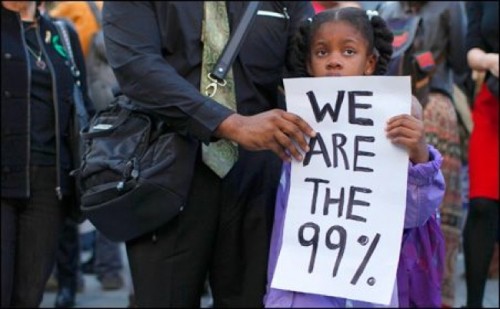
Within days, the Occupy Movement became a world symbol with the universal slogan “We are the 99%”. Jobless and homeless, union members and priests, nurses, teachers and students stood in protest, peacefully marched down streets, built camps with libraries in parks and city squares, tried to make their stand in the face of forced evictions. But capital’s dictatorial force prevailed. Occupy Movement protesters have been arrested, their camps bulldozed.
Occupy Movement campaigned to move homeless people into buildings foreclosed by banks, stood by labor’s struggle, and has tried to widen its support-base. Defying cold, rain, snow falls and evictions in countries, Occupy Movement protesters are still undaunted, and hope to re-occupy public spaces.
Now, it is Occupy Everywhere. It’s a new discourse and dynamics of political action. It is not an isolated act of protest. Rather, it is now a worldwide process, an expression of revolt against capitalist economy and politics.
Labor, either in unions or defying status quoed union leadership, in countries has joined the waves of uprising, and in countries has determined pace of politics for a period, may be for a short one. Labor worldwide is trying to assert its position. In 2011, labor made strikes at Australian coal mines and walked outs at giant Grasberg mine in Indonesia. Chile’s state-owned copper giant, African gold producers, and scores of mine owners in countries had to face labor action in the year.
At least in a country, a new law banning street protest has been enacted. At least a country now plans to use its political power to detain its citizens for indefinite period. Police reportedly went undercover at an Occupy camp to find out protesters’ intentions. Police spies infiltrated protest groups at least in a country. In countries, public servants, hardly a few thousands in number, are wielding the power to define limits of “democracy” for millions, and in actual sense, billions. The year 2011 once again exposed these truths.
In 2011, by violating fundamental rights of people, and even by violating bourgeois democratic norms, ruling classes in respective societies have quashed its claims to rule, have confirmed its void moral standing, and have provided people the logic to reclaim fundamental features of bourgeois democracy and public spaces. In 2011, ruling machines in countries are breaking its laws the machines are committed to safeguard, and breeding contempt of the laws enacted to secure existing property relations and perpetuate dominance over people. In countries, honesty is an abandoned concept within forces of and institutions for hegemony. So, the logic to reclaim comes from Abraham Lincoln. In 1858, Abraham Lincoln said while debating Stephen Douglas: “We the people are the rightful masters of both Congress and the courts, not to overthrow the Constitution but to overthrow the men who pervert the Constitution.”
In 2011, capital’s “holy” alliance is being exposed. States with their inherent inefficiency and incompetence continue to stand as inefficient and incompetent. With their monopoly of coercion states are attaining mistrust of its citizens.
In 2011, main stream media got exposed as a tool of capital. MSM’s acts appeared deep rooted conspiracy, often a conspiracy of silence, to the protesting people. It tried to keep silent on the Occupy Movement. Its “shrewd” tact to ignore people’s struggles ultimately breached its credibility, and to regain credibility, it had to provide information, sometimes disinformation or misinformation.
In 2011, the dominating economy’s incapability is being exposed as it continues to snatch away social safety arrangements, as it fails to provide bare minimum livelihood space to citizens, and as it fails to balance its competing interests. In a continent, dominating capital stands on the brink of falling apart as its powerful parts fail to resolve fatal competition.
In 2011, like past years, states, huge in number, continue to serve their masters – capitals, monopoly finance capital, speculator capital, ecocide capital, war capital. With demagoguery and outright falsehood, with a state of war or a threat of war, with justification to torture and murder, states fomented protests, revolts and occupation in 2011.
Status quo is engaged with full force in stopping peoples’ legitimate claims on economy and politics. In 2011, societies are on the border of bankruptcy, societies are faltering with burden of seemingly endless mal-governance, lumpenocracy, immense corruption and hopelessness. Dominating classes’ historical role has brought the societies to this limit. The dominating classes have initiated the process of destruction of these societies. In countries, people found no other way but protest and revolt in 2011 as speculators and bankers shape economy and trample sovereignty, polluters define limits of livable environment, and tyranny encroach public spaces. All Tyranny depends on deception, hypocrisy, economic and political power, and compels people to resort to revolt. The year, as a reaction, demonstrates force and power of revolt. The year is witnessing unimaginable riches and military might, but finds it imprisoned to the desire to use the power in the interests of absolute minority section in societies. People find them encountering tyranny and oppression in the guise of status quo in 2011.
“No nation”, as James Madison said in Political Observations in 1795, “can preserve its freedom in the midst of continual warfare.” But, the world is experiencing continual war waged by dominating capital. The year 2011 with pain and tears is going through this war. It is war for resources and cheap labor being waged in lands around the globe, it is war for thievery, it is wars declared and undeclared, and it is age-old war waged by a minority class against the majority classes. Under the endless sky, it is being waged in politics, in diplomacy, in economy, in propaganda, in ideology and education. It is being waged in the squares of the cities, in slums, on waste dumping grounds, with public properties being sold in market, in factories and workshops, in ports and offices, in degraded educational institutions and hospitals without any ribbon of hope, in all public spaces.
In countries, people are now no more wandering, no more having aimless moves in 2011. In countries, people are now striving to transform politics, taking initiatives in politics with limitations imposed by a period and respective societies. Despite the fact, protesting people, revolting people, not individuals, have initiated a process to reclaim their space, their land, to reiterate
This land is your land,
This land is my land
This land is our land.
Dhaka-based freelancer Farooque Chowdhury contributes on socioeconomic issues.
OCCUPY THE FUTURE

Axis of Justice
December 20 2011
MICHAEL VENTURA
LETTERS AT 3AM –
OCCUPY THE FUTURE
Austin Chronicle – December 16, 2011
“I’ll believe corporations are people when Texas executes one.”
The person who created that sign in Zuccotti Park put her or his anonymous finger on the heartbeat of Occupy.
Many wonder what Occupy stands for and why Occupy has not made specific demands – as though it’s not enough that, in Occupy’s brief existence, its participants have emblazoned the difference between the 1% and the 99% upon the consciousness of America. As my longtime colleague Ginger Varney said, “They’ve changed the conversation.”
In his recent speech about the economy, the president referenced the 1% and 99% disparity because he had to; for now, no one can credibly discuss economics without mentioning the 1% and the 99%. Occupy has, indeed, changed the conversation – an achievement that cannot be overestimated.
It’s not my place to speak for Occupy, but I’ll use my own “people’s mic” to offer a proposal: that Occupy demands a constitutional amendment to reverse Supreme Court decisions that have given corporations the rights of citizens. Carefully craft this amendment to make clear, beyond doubt, that a corporation does not enjoy or deserve the constitutional rights of a citizen. Rather, a for-profit corporation is a commercial venture subject to the republic’s laws governing commerce. This amendment must state and enforce that corporations are not people.
Change the Supreme Court’s stance that corporations are people and you change the fundamental rule under cover of which corporations conduct themselves. The passage such an amendment would go a very long way toward getting corporate money out of American politics.
That would be a revolution. It would change the electoral playing field.
In the election year of 2012, anyone running for any office should be made to take a stand on this amendment and answer this question: Do you believe a corporation should have the rights of an individual citizen — yes or no?
The answer to that direct and simple (but not simplistic) question would indicate which side an office-seeker is on, the 1% or the 99%?
Thus the 2012 election would not be about Democrats, Republicans, independents, tea partiers, or Occupy. Instead, the election would be about one central, crucial issue: Do you serve the 1% or the 99%?
You can’t call it a “class war” when the class you defend is 99% of the population.
Make the “corporations are not people” amendment central to the election and you begin the nonviolent, constitutional revolution in commerce that we desperately need.
Now let’s clarify a matter of history.
Economic conservatives – servants of the 1% — claim that all challenges to their conception of capitalism are European in origin, a not-so-subtle way of calling challenges to corporate capitalism un-American.
Those conservatives need a history lesson.
Robert L. Heilbroner, in his classic economics study The Worldly Philosophers (Revised Seventh Edition), reminds us that in Boston in 1639 – just nine years after Puritans founded the city — “one Robert Keayne … [was] charged with a heinous crime: he [had] made over sixpence profit on the shilling, an outrageous gain. The court [debated] whether to excommunicate him for his sin, but … it finally [relented] and [dismissed] him with a fine of two hundred pounds,” an enormous sum in that time and place. Kearyne was so contrite that “before the elders of the Church” he “with tears acknowledged his covetous and corrupt heart.” The first Anglo-Americans considered undue profit “covetous and corrupt.”
That wasn’t the end of it. The minister of Boston used Kearyne’s offense to “thunder forth in his Sunday sermon on some false principles of trade.” In the minister’s words, the most heinous and false principle of trade was this:
“That a man might sell as dear and he can, and buy as cheap as he can.”
Heilbroner: “Even to our Pilgrim forefathers, the idea that [commercial] gain might be a tolerable – even a useful – goal in life would have appeared as nothing short of a doctrine of the devil.”
The ideals of Occupy are as American as the Pilgrims.
Fast forward to Dec. 3, 1861. Abraham Lincoln, the greatest Republican president, included these words in his Annual Message to Congress (excerpted from Abraham Lincoln: Speeches and Writings, 1859-1865):
“[T]here is one point … to which I ask a brief attention. It is the effort to place capital on an equal footing with, if not above, labor, in the structure of government [Lincoln’s italics]. It is assumed that labor is available only in connection with capital; that nobody labors unless somebody else, owning capital, somehow by the use of it, induces him to labor. … Now, there is no such relation between capital and labor as assumed; nor is there any such thing as a free man being fixed for life in the condition of a hired laborer. Both these assumptions are false, and all inferences from them are groundless. Labor is prior to, and independent of, capital. Capital is only the fruit of labor, and could never have existed if labor had not first existed. Labor is the superior of capital, and deserves much the higher consideration. Capital has its rights, which are as worthy of protection as any other rights. Nor is it denied that there is, and probably always will be, a relation between labor and capital, producing mutual benefits. … This is the just, and generous, and prosperous system, which opens the way to all – gives hope to all, and consequent energy, and progress, and improvement of condition to all. No men living are more worthy to be trusted than those who toil up from poverty – none less inclined to take, or touch, aught which they have not honestly earned. Let them beware of surrendering a political power which they already possess, and which, if surrendered, will surely be used to close the door of advancement against such as they, and to fix new disabilities and burdens upon them, till all of liberty shall be lost.”
Occupy’s ideals are as American as Abraham Lincoln.
When the Supreme Court bases decisions on the precedent that corporations have the rights of people, it does what Lincoln feared: It fixes new disabilities and burdens upon us, “till all of liberty shall be lost.”
We can change this. It’s been done before.
Until the Civil War, the Supreme Court justified slavery. The 13th and 14th amendments (1865 and1868) changed that.
Until 1920, American women were denied the vote. The 19th amendment changed that.
Until 1964, Southern states enforced segregation by tactics such as poll taxes. The 24th amendment made those tactics illegal.
Through an amendment to the constitution, we can change the legal status of corporations. We can do it now.
Mayer Vishner, a lifelong activist, has witnessed Occupy Wall Street up close since the first day. He tells me, “Occupy is not an event, it’s not a movement, and it’s not a protest. It’s a consciousness shift.”
America was created by a shift in consciousness, as recalled by John Adams in an 1815 letter to Thomas Jefferson:
“What do we mean by the Revolution? The war? That was no part of the Revolution; it was only an effect and consequence of it. The Revolution was in the minds of the people, and this was effected from 1760–1775, in the course of fifteen years before a drop of blood was shed at Lexington.”
Occupy is as American as Adams and Jefferson. Occupy marks a shift in consciousness that can lead to a new and freer world. Occupy is not about this or that plot of ground. The mission of Occupy is to occupy the future.
Sunday, December 18
Obama Signs NDAA Martial Law
While Americans shopped, the Constitution was shredded
[Video Mirror]
President Barack Obama faced a civil liberties backlash today after he signed a law that will allow terror suspects to be held indefinitely- even raising the prospects of U.S. citizens being sent to Guantanamo Bay.
The controversial move, revealed last night, effectively extends the laws of the battlefield to American soil.
The move shows a clear hardening of Mr Obama’s anti-terror policies, and a major shift from the liberal stance that helped him sweep into power three years ago.
After campaigning heavily on the need to close the controversial terrorist detention base at Guantanamo Bay, he failed to deliver when met with legal obstacles.
Now, showing that he has truly moved to the opposite end of the spectrum, he is endorsing the tools and civil powers that he once rallied against.
'It's something so radical that it would have been considered crazy had it been pushed by the Bush administration,' said Human Rights Watch spokesman Tom Malinowski.
It establishes precisely the kind of system that the United States has consistently urged other countries not to adopt. At a time when the United States is urging Egypt, for example, to scrap its emergency law and military courts, this is not consistent,' Mr Malinowski continued.
Considering he is now in the midst of running for re-election, comparisons between Mr Obama and Mr Bush are certainly not something the President wants going into the 2012 race.
Civil rights groups are outraged after he dropped the threat of a veto Wednesday, meaning the bill will become a law and implement several controversial provisions, like the ability to keep all terror suspects imprisoned.
Read more here.
Poll: Majority of Americans Willing to Throw Down in the Class War
AlterNet
[REPRINT]
Greg Sargent breaks down the new Pew Poll, which apparently shows that a majority of Americans are more than willing to throw down in the class war. It's quite inspiring when you think about it. Seems that no matter how hard the 1% tried it can't quite convince the people that they should put their own needs behind those of the millionaire "jaaahb creators."
But as Greg point out, this is not guarantee that the new populist rhetoric from the president or the congressional Democrats will trump the bad economy. After all, as Rick Perlstein noted in this article from a while back, modern liberalism, properly understood, is "freedom, plus groceries":
Needless to say, the freedom part is literally compromised by decisions to legalize indefinite detention without trial, but for the purposes of this discussion, it's the groceries that are causing the problem --- or rather lack thereof. The Democrats are simply not responding to the immediate concerns of a majority of Americans. Even health care, which is a great anxiety producing issue, is still fraught with confusion (although its early benefits are beginning to register a bit.) The more immediate issues of a foreclosure fraud crisis and all the problems associated with it, unemployment and job insecurity and massive numbers falling into poverty while the wealthy pig out (and whine about it) is what has people up in arms. They need government to deliver some groceries and the government is instead putting them on a diet.
Conservatives don't believe in delivering groceries, of course. When they aren't stealing the milk money and handing it out to their rich friends to pay back their donations, they're indifferent at best. It's liberals who are supposed to deliver at times like this and instead of doing that they are cutting deals to shrink the existing, tattered safety net in the future in order to keep the economy from sinking further in the present. (It's not all their fault, but being ineffectual doesn't rally the troops.)
The populist rhetoric is welcome, of course. At least it's beginning to reframe the argument away from the destructive notion that government deficits caused the economic crisis.(Unfortunately, there's still a lot of work to do on that.) But it's going to be very tough if Democrats keep compromising on the groceries.
We still don't know what deal, if any, is going to emerge on the budget. The Democrats have evidently given up entirely on the millionaire surtax, which I indicated earlier isn't all that surprising. The question now is whether the Republicans will be able to coerce them into accepting their odious cuts to pay for the payroll tax cut and unemployment extensions. That's not delivering groceries, it's eating your seed corn.
By Digby | Sourced from Hullabaloo
Posted at December 16, 2011, 1:28 pm
[REPRINT]
Greg Sargent breaks down the new Pew Poll, which apparently shows that a majority of Americans are more than willing to throw down in the class war. It's quite inspiring when you think about it. Seems that no matter how hard the 1% tried it can't quite convince the people that they should put their own needs behind those of the millionaire "jaaahb creators."
But as Greg point out, this is not guarantee that the new populist rhetoric from the president or the congressional Democrats will trump the bad economy. After all, as Rick Perlstein noted in this article from a while back, modern liberalism, properly understood, is "freedom, plus groceries":
This beast we call “liberalism”—in its genus Americanus, at least—is a notoriously complicated animal. Its philosophy is rooted in the notion of human beings as autonomous agents. With the realization that formal autonomy meant little without the means to sustain a decent life, its practical definition in this century came to encompass the various kinds of government arrangements democratically devised to share the social burden. What we now mean by the word was summarized with unmatched elegance by Maury Maverick, the Texas congressman who led a caucus in the 1930s that tried to push the New Deal to the left. He called liberalism “freedom plus groceries.” As a definition, it cannot be improved upon—although scholars may prefer John Rawls’s formulation, that for justice to thrive the minimum worth of liberty must be maximized.
The groceries part, the different ways in which liberals devised to vouchsafe enough material resources for everyone (whatever the divergent conceptions of “enough”), makes for a complex history. I won’t get into the technicalities except to note the existence of the commitment as one of liberalism’s constants and to observe that such a commitment almost invariably requires a political imagination geared toward the long term.
Needless to say, the freedom part is literally compromised by decisions to legalize indefinite detention without trial, but for the purposes of this discussion, it's the groceries that are causing the problem --- or rather lack thereof. The Democrats are simply not responding to the immediate concerns of a majority of Americans. Even health care, which is a great anxiety producing issue, is still fraught with confusion (although its early benefits are beginning to register a bit.) The more immediate issues of a foreclosure fraud crisis and all the problems associated with it, unemployment and job insecurity and massive numbers falling into poverty while the wealthy pig out (and whine about it) is what has people up in arms. They need government to deliver some groceries and the government is instead putting them on a diet.
Conservatives don't believe in delivering groceries, of course. When they aren't stealing the milk money and handing it out to their rich friends to pay back their donations, they're indifferent at best. It's liberals who are supposed to deliver at times like this and instead of doing that they are cutting deals to shrink the existing, tattered safety net in the future in order to keep the economy from sinking further in the present. (It's not all their fault, but being ineffectual doesn't rally the troops.)
The populist rhetoric is welcome, of course. At least it's beginning to reframe the argument away from the destructive notion that government deficits caused the economic crisis.(Unfortunately, there's still a lot of work to do on that.) But it's going to be very tough if Democrats keep compromising on the groceries.
We still don't know what deal, if any, is going to emerge on the budget. The Democrats have evidently given up entirely on the millionaire surtax, which I indicated earlier isn't all that surprising. The question now is whether the Republicans will be able to coerce them into accepting their odious cuts to pay for the payroll tax cut and unemployment extensions. That's not delivering groceries, it's eating your seed corn.
By Digby | Sourced from Hullabaloo
Posted at December 16, 2011, 1:28 pm
Wednesday, December 14
Person of the Year 2011

The Protester - 2011 - TIME
By Kurt Andersen Wednesday, Dec. 14, 2011
[REPRINT]
Once upon a time, when major news events were chronicled strictly by professionals and printed on paper or transmitted through the air by the few for the masses, protesters were prime makers of history. Back then, when citizen multitudes took to the streets without weapons to declare themselves opposed, it was the very definition of news — vivid, important, often consequential. In the 1960s in America they marched for civil rights and against the Vietnam War; in the '70s, they rose up in Iran and Portugal; in the '80s, they spoke out against nuclear weapons in the U.S. and Europe, against Israeli occupation of the West Bank and Gaza, against communist tyranny in Tiananmen Square and Eastern Europe. Protest was the natural continuation of politics by other means.
And then came the End of History, summed up by Francis Fukuyama's influential 1989 essay declaring that mankind had arrived at the "end point of ... ideological evolution" in globally triumphant "Western liberalism." The two decades beginning in 1991 witnessed the greatest rise in living standards that the world has ever known. Credit was easy, complacency and apathy were rife, and street protests looked like pointless emotional sideshows — obsolete, quaint, the equivalent of cavalry to mid-20th-century war. The rare large demonstrations in the rich world seemed ineffectual and irrelevant. (See the Battle of Seattle, 1999.)
There were a few exceptions, like the protests that, along with sanctions, helped end apartheid in South Africa in 1994. But for young people, radical critiques and protests against the system were mostly confined to pop-culture fantasy: "Fight the Power" was a song on a platinum-selling album, Rage Against the Machine was a platinum-selling band, and the beloved brave rebels fighting the all-encompassing global oppressors were just a bunch of characters in The Matrix. (See pictures of protesters around the world.)
"Massive and effective street protest" was a global oxymoron until — suddenly, shockingly — starting exactly a year ago, it became the defining trope of our times. And the protester once again became a maker of history.
Prelude to the Revolutions
It began in Tunisia, where the dictator's power grabbing and high living crossed a line of shamelessness, and a commonplace bit of government callousness against an ordinary citizen — a 26-year-old street vendor named Mohamed Bouazizi — became the final straw. Bouazizi lived in the charmless Tunisian town of Sidi Bouzid, 125 miles south of Tunis. On a Friday morning almost exactly a year ago, he set out for work, selling produce from a cart. Police had hassled Bouazizi routinely for years, his family says, fining him, making him jump through bureaucratic hoops. On Dec. 17, 2010, a cop started giving him grief yet again. She confiscated his scale and allegedly slapped him. He walked straight to the provincial-capital building to complain and got no response. At the gate, he drenched himself in paint thinner and lit a match. (See pictures of Sidi Bouzid.)
"My son set himself on fire for dignity," Mannoubia Bouazizi told me when I visited her.
"In Tunisia," added her 16-year-old daughter Basma, "dignity is more important than bread."
In Egypt the incitements were a preposterously fraudulent 2010 national election and, as in Tunisia, a not uncommon act of unforgivable brutality by security agents. In the U.S., three acute and overlapping money crises — tanked economy, systemic financial recklessness, gigantic public debt — along with ongoing revelations of double dealing by banks, new state laws making certain public-employee-union demands illegal and the refusal of Congress to consider even slightly higher taxes on the very highest incomes mobilized Occupy Wall Street and its millions of supporters. In Russia it was the realization that another six (or 12) years of Vladimir Putin might not lead to greater prosperity and democratic normality.
In Sidi Bouzid and Tunis, in Alexandria and Cairo; in Arab cities and towns across the 6,000 miles from the Persian Gulf to the Atlantic Ocean; in Madrid and Athens and London and Tel Aviv; in Mexico and India and Chile, where citizens mobilized against crime and corruption; in New York and Moscow and dozens of other U.S. and Russian cities, the loathing and anger at governments and their cronies became uncontainable and fed on itself.
The stakes are very different in different places. In North America and most of Europe, there are no dictators, and dissidents don't get tortured. Any day that Tunisians, Egyptians or Syrians occupy streets and squares, they know that some of them might be beaten or shot, not just pepper-sprayed or flex-cuffed. The protesters in the Middle East and North Africa are literally dying to get political systems that roughly resemble the ones that seem intolerably undemocratic to protesters in Madrid, Athens, London and New York City. "I think other parts of the world," says Frank Castro, 53, a Teamster who drives a cement mixer for a living and helped occupy Oakland, Calif., "have more balls than we do."
In Egypt and Tunisia, I talked with revolutionaries who were M.B.A.s, physicians and filmmakers as well as the young daughters of a provincial olive picker and a supergeeky 29-year-old Muslim Brotherhood member carrying a Tigger notebook. The Occupy movement in the U.S. was set in motion by a couple of magazine editors — a 69-year-old Canadian, a 29-year-old African American — and a 50-year-old anthropologist, but airline pilots and grandmas and shop clerks and dishwashers have been part of the throngs.
In a new book from TIME, What Is Occupy? Inside the Global Movement, our journalists explore the roots and meaning of the uprising over economic justice. To buy a copy as an e-book or a paperback, go to time.com/whatisoccupy.
THE ARTICLE CONTINUES HERE.
Thursday, December 8
Military to Gain Power of Indefinite Detention in Senate Bill
Ray McGovern: Amendment to NDAA gives military the right to operate on American soil, detain people without trial for an indefinite period of time including US citizens
Wednesday, December 7
Anonymous - Message to the American People
Dear brothers and sisters. Now is the time to open your eyes!
In a stunning move that has civil libertarians stuttering with disbelief, the U.S. Senate has just passed a bill that effectively ends the Bill of Rights in America.
The National Defense Authorization Act is being called the most traitorous act ever witnessed in the Senate, and the language of the bill is cleverly designed to make you think it doesn't apply to Americans, but toward the end of the bill, it essentially says it can apply to Americans "if we want it to.
Bill Summary & Status, 112th Congress (2011 -- 2012) | S.1867 | Latest Title: National Defense Authorization Act for.
This bill, passed late last night in a 93-7 vote, declares the entire USA to be a "battleground" upon which U.S. military forces can operate with impunity, overriding Posse Comitatus and granting the military the unchecked power to arrest, detain, interrogate and even assassinate U.S. citizens with impunity.
Even WIRED magazine was outraged at this bill, reporting:
Senate Wants the Military to Lock You Up Without Trial
...the detention mandate to use indefinite military detention in terrorism cases isn't limited to foreigners. It's confusing, because two different sections of the bill seem to contradict each other, but in the judgment of the University of Texas' Robert Chesney — a nonpartisan authority on military detention — "U.S. citizens are included in the grant of detention authority."
The passage of this law is nothing less than an outright declaration of WAR against the American People by the military-connected power elite. If this is signed into law, it will shred the remaining tenants of the Bill of Rights and unleash upon America a total military dictatorship, complete with secret arrests, secret prisons, unlawful interrogations, indefinite detainment without ever being charged with a crime, the torture of Americans and even the "legitimate assassination" of U.S. citizens right here on American soil!
If you have not yet woken up to the reality of the police state we've been warning you about, I hope you realize we are fast running out of time. Once this becomes law, you have no rights whatsoever in America. — no due process, no First Amendment speech rights, no right to remain silent, nothing.
The US senate does not want us to speak. I suspect even now orders are being shouted into telephones and men with guns will soon be on their way. Why? Because while the truncheon may be used in lieu of conversation, words will always retain their power. Words offer the means to meaning and for those who will listen, the enunciation of truth. And the truth is, there is something terribly wrong with this country, isn't there? Cruelty and injustice...intolerance and oppression. And where once you had the freedom to object, to think and speak as you saw fit, you now have censors and systems of surveillance, coercing your conformity and soliciting your submission. How did this happen? Who's to blame? Well certainly there are those who are more responsible than others, and they will be held accountable. But again, truth be told...if you're looking for the guilty, you need only look into a mirror.
I know why you did it. I know you were afraid. Who wouldn't be? War. Terror. Disease. There were a myriad of problems which conspired to corrupt your reason and rob you of your common sense. Fear got the best of you and in your panic, you turned to the now President in command Barack Obama. He promised you order. He promised you peace. And all he demanded in return was your silent, obedient consent.
More than four hundred years ago, a great citizen wished to embed the fifth of November forever in our memory. His hope was to remind the world that fairness. Justice, and freedom are more than words - they are perspectives. So if you've seen nothing, if the crimes of this government remain unknown to you, then I would suggest that you allow the fifth of November to pass unmarked. But if you see what I see, if you feel as I feel, and if you would seek as I seek...then I ask you to stand beside one another, one year from November 5th, 2011, outside the gates of every court house of every city DEMANDING our rights!!
Together we stand against the injustice of our own Government.
We are anonymous.
We are Legion.
United as ONE.
Divided by zero.
We do not forgive Censorship.
We do not forget Oppression.
US SENATE...
Expect us!!
Music by: Wolfgang Amadeus Mozart - Requiem
Saturday, December 3
S 1867: Killing The Bill of Rights and Declaring War on Americans
S 1867: Killing The Bill of Rights and Declaring War on Americans - By Tim Gatto
[REPRINT]
03 December, 2011
Countercurrents.org
This is an article that I MUST write about. If I don't write this article than I have no right to ever write another. The reason is because the most despicable and damaging piece of legislation ever passed was passed in the Senate late last night without hardly a whimper in the morning from the American mainstream press. Under the cover of darkness, the United States Senate virtually declared war on the people of this nation by passing the darkest piece of legislation ever passed in America.
If the House of Representatives passes its version and the President then puts his signature on it and turning it into law, almost every right under the Bill of Rights will be stripped away from the people of the United States. This will be the final nail in the coffin of democracy in America. We will become a military police state and cease to be a democracy or a representative republic or whatever else it has been called. According to the definition under this amendment to the military appropriations bill, the nation will become a part of a world-wide “battle zone”.” If this is signed into law, it will shred the remaining tenants of the Bill of Rights and unleash upon America a total military dictatorship, complete with secret arrests, secret prisons, unlawful interrogations and indefinite detainment without people ever being charged with a crime. It will cause the torture of Americans and even the "legitimate assassination" of U.S. citizens overseas and also right here on American soil!
If you have not yet woken up to the reality of this looming police state we've been morphing into, the police state that so many have warning about, I sincerely hope that most of you realize that we are fast running out of time. Once this becomes law, you will be living in a different kind of America, one that no longer guarantees certain inalienable rights. Americans will have no rights whatsoever in America -- no due process, no First Amendment speech rights, no right to remain silent or to be tried by a jury of your peers. You will only have the right to a military tribunal with a military judge and a military lawyer. In other words, Americans will be afforded the same rights as an enemy combatant in the “battlefield” of America.
Some of you may be wondering why you haven't been told about this by the major news networks? That is a legitimate question. The information about this bill, S.1867, is conflicting. According to “Wired”:
“Here's the best thing that can be said about the new detention powers the Senate has tucked into next year's defense bill: They don't force the military to detain American citizens indefinitely without a trial. They just let the military do that. And even though the leaders of the military and the spy community have said they want no such power, the Senate is poised to pass its bill as early as tonight. There are still changes swirling around the Senate, but this looks like the basic shape of the 2012 National Defense Authorization Act. Someone the government says is “a member of, or part of, al-Qaida or an associated force” can be held in military custody “without trial until the end of the hostilities authorized by the Authorization for Use of Military Force.” Those hostilities are currently scheduled to end the Wednesday after never. The move would shut down criminal trials for terror suspects”.
The language of the bill is ambiguous. Also from “Wired” “ So despite the Sixth Amendment's guarantee of a right to trial, the Senate bill would let the government lock up any citizen it swears is a terrorist, without the burden of proving its case to an independent judge, and for the lifespan of an amorphous war that conceivably will never end. And because the Senate is using the bill that authorizes funding for the military as its vehicle for this dramatic constitutional claim, it's pretty likely to pass.”
Defense Secretary Leon Panetta and CIA Director David Petraeus both say that they are opposed to the bill. Why then is it being written into the Defense Budget that is very likely to pass? Who is behind this most brazen attack on the rights of Americans in history? Senator Carl Levin is the architect of this bill but the two men that are really behind this savaging of American's basic rights are Senators John McCain and Senator Lindsay Graham along with Joe Liebermann according to InfoWar's Alex Jones. Levin defends the bill by claiming that “The requirement to detain a person in military custody under this section does not extend to citizens of the United States.” Still, while the bill would not force the government to try American citizens by military tribunal, it nevertheless would allow them to do so.
Civil libertarians aren't so sure. Sen. Al Franken (D-Minn.) said it “denigrates the very foundations of this country.” Sen. Rand Paul (R-Ky.) added, “it puts every single American citizen at risk.”
timgatto@hotmail.com
Read Tim's novel "Kimchee Days" and his political Book "Complicity to Contempt" from Oliver Arts and Open Press.
The Uprising of 2012?

The Uprising of 2012? | Common Dreams
Published on Sunday, November 27, 2011 by the Boston Globe
The Uprising of 2012?
by Kara Miller
[REPRINT]
Around the world, this has been the year of uprisings - spurred in large part by financial concerns.
Athens, of course, has witnessed months of fiery protests. But the disaffected have also crowded the streets of Paris, London, Rome, and New York.
And economic woes extend far beyond the obvious.
As former New York Times war reporter - and current Truthdig columnist - Chris Hedges told me in August, the Arab Spring had a lot "to do with food prices. Commodity prices - especially wheat, which has increased in price by 100% in past eight months - has really made it difficult for families, especially poor families - and half of the population in Egypt lives on about two dollars a day - to feed themselves."
Hedges argued that skyrocketing prices helped foment dissatisfaction - and pushed people into the streets. "And that's why, if you looked closely," he said, "you saw within the crowds oftentimes, people actually carrying loaves of bread. And that's not going to go away."
Indeed, on the day before Thanksgiving, The Financial Times reported that more then 40% of food producers intend to hike consumer prices in the next few months, attempting to compensate for the rising cost of raw materials.
But the problem encompasses much more than food. Jeffrey Sachs, a professor at Columbia, wrote recently that the cost of education continues to outpace inflation - even as a four-year degree becomes a prerequisite for a comfortable, middle-class life. "Poor kids can't meet tuition," wrote Sachs, "and they drop out of college in droves. Yet with more cuts in state support for tuition and in federal Pell Grants, the situation is rapidly getting worse."
A few of the families that can't afford high tuitions protest. But most just feel angry, dispirited, and betrayed.
Still, as Sachs says, there is a strange, alternate narrative: "we have two economies, not one. The economy of rich Americans is booming. Salaries are high. Profits are soaring. Luxury brands and upscale restaurants are packed. There is no recession."
Hit up some of the more expensive restaurants in Boston, and you'll see $45 steaks and $60 bottles of wine liberally dotting packed tables.
The question, then - as prices for food, education, and health care continue to rise - is how long dissatisfaction can be contained.
"I drive by gated communities," the renowned geographer Jared Diamond wrote a few years ago, "guarded by private security patrols, and filled with people who drink bottled water, depend on private pensions, and send their children to private schools."
But financial insecurity can prove combustible. As Greece, the Arab Spring, and Occupy Wall Street have so powerfully demonstrated.
"If conditions deteriorate too much for poorer people," Diamond says, with a nod to history, "gates will not keep the rioters out."
2011 may have seemed like a year of upheaval. But the real fireworks could be yet to come.
© 2011 Kara Miller
Kara Miller is an Assistant Professor of English, specializing in journalism, at the University of Massachusetts at Dartmouth. She also serves as a guest panelist on WGBH-TV's “Beat the Press” and contributes to 89.7 FM WGBH (NPR). She received her Ph.D. from Tufts University, where she focused on how presidents communicate with the public during wartime.
Thursday, December 1
[Video] Battlefield America
Battlefield America: US Citizens Face Indefinite Military Detention in Senate Defense Bill
FOLLOW DEMOCRACY NOW! ONLINE:
Facebook: http://www.facebook.com/democracynow
Twitter: @democracynow
Subscribe on YouTube: http://www.youtube.com/democracynow
Daily Email News Digest: http://www.democracynow.org/subscribe
Please consider supporting independent media by making a donation to Democracy Now!
today, visit http://www.democracynow.org/donate/YT
Subscribe to:
Posts (Atom)
