AlterNet
[REPRINT]

Thursday, September 29
The Illusion of the American Dream
The Illusion of the American Dream
[REPRINT]
By Bohemian
"It's called the American Dream because you have to be asleep to believe it." George Carlin
September 28, 2011 "Bohemian Travelers" -- Once upon a time, I woke up and realized the American Dream was an illusion; a myth, a shiny-but-inedible carrot used to trap us into a narrow range of experiences, often referred to as the rat race.
The American dream philosophy started at the inception of the country -- that all people were created equal in the pursuit of happiness. The basic idea became that if you study, work hard, and play by the rules you will have prosperity and success. This idea brought, and still brings, many immigrants to the US. I have no doubt that if someone is dedicated, smart, and talented, this is still the case despite increased challenges.
The illusion is that the American Dream can be conventionally defined for everyone. Is it having a good job with health benefits for the accumulation of material things? Or, is it the freedom to pursue passions and have amazing experiences? Perhaps true success is a balance of all those things.
We've been lucky enough to have already lived both extremes of this paradigm, but are still in pursuit of the perfect balance part. At one point we were rat-racers through and through; with the big house, two cars, bills and debt, two full-time jobs, toys, etc. It was all well and good, and certainly we found much joy in that life, but it made us feel trapped. The notion of doing the same routine for the next forty to fifty years just to pay off our stuff and retire modestly really started to bum us out.
We began to wonder if this was the best way to experience our precious time on this planet. Was it the experience we wanted for our kids? What if there was another way to live that didn't include meaningless tasks and obligations? Would we be able to sustain ourselves if we quit the traditional version of the American Dream? The answer lies in our blog's tagline: Exit Rat Race, Enter Adventure.
Somewhere during this transition we realized that we never truly "own" anything, we just use it. This was made clear when we calculated that even if our home was paid off, we would still have to pay nearly $800 in monthly taxes, insurance etc. That's not ownership, especially when you can rent a home with 4 acres in Costa Rica or a villa in Thailand for half of that, it is a trap. This is when we realized that the carrot was inedible. Sure, it's nice have cool things to "use", but at what cost?
My husband and I decided to change our interpretation of the dream from the accumulation of stuff to the accumulation of experiences. We sold everything except personal items, quit our jobs, and decided on a life of nomadic travel. Many of our loved ones were puzzled by our rejection of the traditional American Dream, yet nearly all of them admired our courage.
As is the challenge for anyone seeking to survive in this world, a balance of work and play still had to be found. First, we realized that in order to make our new dream come true we had to simplify our lives. Unexpectedly, that simplification process became quite rewarding and has rarely felt like we sacrificed anything. We also had to find ways to make money conducive to traveling. This has been a bumpier road but one that has ultimately led to getting paid to do what we love.
Our family has gone through many changes over the past few years. From simplifying our lives to realizing that enjoying the journey is the goal. Perhaps the most important thing we have learned is that we are in control of ourselves and our path. We alone set the tempo for living out our dreams. We can live any illusion we choose, but we must dream it first. For us, the American Dream represents the freedom to choose how to spend our time.
We choose simplicity, independence, and global exploration. What do you CHOOSE?
[REPRINT]
By Bohemian
"It's called the American Dream because you have to be asleep to believe it." George Carlin
September 28, 2011 "Bohemian Travelers" -- Once upon a time, I woke up and realized the American Dream was an illusion; a myth, a shiny-but-inedible carrot used to trap us into a narrow range of experiences, often referred to as the rat race.
The American dream philosophy started at the inception of the country -- that all people were created equal in the pursuit of happiness. The basic idea became that if you study, work hard, and play by the rules you will have prosperity and success. This idea brought, and still brings, many immigrants to the US. I have no doubt that if someone is dedicated, smart, and talented, this is still the case despite increased challenges.
The illusion is that the American Dream can be conventionally defined for everyone. Is it having a good job with health benefits for the accumulation of material things? Or, is it the freedom to pursue passions and have amazing experiences? Perhaps true success is a balance of all those things.
We've been lucky enough to have already lived both extremes of this paradigm, but are still in pursuit of the perfect balance part. At one point we were rat-racers through and through; with the big house, two cars, bills and debt, two full-time jobs, toys, etc. It was all well and good, and certainly we found much joy in that life, but it made us feel trapped. The notion of doing the same routine for the next forty to fifty years just to pay off our stuff and retire modestly really started to bum us out.
We began to wonder if this was the best way to experience our precious time on this planet. Was it the experience we wanted for our kids? What if there was another way to live that didn't include meaningless tasks and obligations? Would we be able to sustain ourselves if we quit the traditional version of the American Dream? The answer lies in our blog's tagline: Exit Rat Race, Enter Adventure.
Somewhere during this transition we realized that we never truly "own" anything, we just use it. This was made clear when we calculated that even if our home was paid off, we would still have to pay nearly $800 in monthly taxes, insurance etc. That's not ownership, especially when you can rent a home with 4 acres in Costa Rica or a villa in Thailand for half of that, it is a trap. This is when we realized that the carrot was inedible. Sure, it's nice have cool things to "use", but at what cost?
My husband and I decided to change our interpretation of the dream from the accumulation of stuff to the accumulation of experiences. We sold everything except personal items, quit our jobs, and decided on a life of nomadic travel. Many of our loved ones were puzzled by our rejection of the traditional American Dream, yet nearly all of them admired our courage.
As is the challenge for anyone seeking to survive in this world, a balance of work and play still had to be found. First, we realized that in order to make our new dream come true we had to simplify our lives. Unexpectedly, that simplification process became quite rewarding and has rarely felt like we sacrificed anything. We also had to find ways to make money conducive to traveling. This has been a bumpier road but one that has ultimately led to getting paid to do what we love.
Our family has gone through many changes over the past few years. From simplifying our lives to realizing that enjoying the journey is the goal. Perhaps the most important thing we have learned is that we are in control of ourselves and our path. We alone set the tempo for living out our dreams. We can live any illusion we choose, but we must dream it first. For us, the American Dream represents the freedom to choose how to spend our time.
We choose simplicity, independence, and global exploration. What do you CHOOSE?


Wednesday, September 28
5 Signs That America Is Moving Away from Religion

5 Signs That America Is Moving Away from Religion
[REPRINT]
September 28, 2011 |
In between bragging about the number of people they've killed and vilifying gay soldiers, the GOP presidential candidates have spent the primaries demonstrating how little they respect the separation of church and state. Michele Bachmann seems to think God is personally invested in her political career. Both she and Rick Perry have ties to Christian Dominionism, a theocratic philosophy that publicly calls for Christian takeover of America's political and civil institutions. (Even Ron Paul, glorified by civil libertarians for his only two good policy stances -- opposition to the Iraq and Afghanistan wars and drug prohibition -- sputtered about churches when asked during a debate where he'd send a gravely ill man without health insurance.)
GOP pandering to the Religious Right is just one of those facts of American public life, like climate change denial and Creationism in schools, that leave secular Americans lamenting the decline of the country, and of reason and logic. Organized religion's grasp on the politics and culture of much of Europe has been waning for decades -- why can't we do that here?
But there are signs that American attitudes are changing in ways that may tame religion's power over political life in the future.
Annie Laurie Gaylor, founder of the Freedom from Religion Foundation, tells AlterNet that she thinks what happened in Europe is (slowly) happening here. While questioning religion remains controversial -- Gaylor says the group's work on church and state issues often elicits hate-mail strongly suggesting they move to, you know, Europe -- atheism, skepticism, and agnosticism are becoming more widely accepted.
"The statistics show there are more of us ... If you're in a room of people you can count on more to agree with non-belief or to be accepting of non-belief," says Gaylor.
Here are five trends that give hope one day religion will reside in the realm of personal choice and private worship, far away from politics -- something like what the Founders intended hundreds of years ago.
1. American religious belief is becoming more fractured
The intrusion of religion into places where it doesn't belong, like government or public education, naturally requires high levels of organization and control -- it's not something that just happens. So it's a good sign that even many Americans who maintain a personal religious faith are distancing themselves from heierarchical, top-down religion. Polls have repeatedly shown that even among the devout, emphatic proclamations of faith do not translate into actual churchgoing. In fact, church attendance rates hovered at around 40 percent until pollsters realized there's a major gap between what Americans tell them about their religious habits and their actual religious habits. Tom Flynn summarizes the over-inflation of US churchgoing and offers more accurate stats:
Americans may believe in a god who sees everything, but they lie about how often they go to church. Since 1939, the Gallup organization has reported that 40% of adults attend church weekly. (The most recent figure is 42%.) Gallup's figure has long attracted skepticism. Were it true, some 73 million people would throng the nation's houses of worship each week. Even the conservative Washington Times found that "hard to imagine." New research suggests that there may be only half to two-thirds that many people in the pews.
Americans are also actively shaping their religious beliefs to fit their own values. Profiled in USA Today, religion statistics expert George Barna shares recent findings that show religion is becoming increasingly personal. Believers might drift from faith to faith until they find one that works for them, or cobble together a belief system drawn from many religious traditions. The US is becoming a place of "310 million people with 310 million religions" Barna is quoted as saying.
2. Non-belief -- and acceptance of non-belief -- on the rise
Last month was the first time atheists were knocked from the top of America's most hated list, an honor that now belongs to the Tea Party. While this development may have more to do with the fact that the mainstream media's love affair with the Tea Party is not shared by most Americans, it also dovetails with increased visibility and acceptance of atheism.
Gaylor tells AlterNet that the FFRF's membership has never been bigger, and her observation conforms to larger trends. In a 2008 study by Connecticut's Trinity college, 15 percent of Americans polled as "nones," a group comprised of vehement atheists, agnostics or people without religious affiliation. In 1990s, only 8.1 percent of the US population could be categorized in this way, according to the report.
In an interview on NPR, Blair Scott, founder of the North Alabama Free Thought Association, says he's noticed people are becoming more and more open-minded about non-belief: "I mean, I've been the victim of discrimination and harassment. They are very real, and they are legitimate concerns that people have. But what we've seen recently is an increase in the general public's, maybe not acceptance, but more curiosity of what atheism is and is not."
Scott also points out that the controversial writing of the New Atheists like Richard Dawkins regularly makes it onto the New York Times bestseller list, which in turn helps popularize atheist arguments and philosophies, even in unexpected places:
I mean, I expect an atheist group in New York, L.A., San Francisco, Seattle, etc. But where we're seeing them pop up is little places like Jackson, Mississippi; Hattiesburg, Mississippi; Tallahassee, Florida, you know, so these little bitty mid-size and small towns, and that's an incredible phenomenon because what that means is that these people are finally willing to say, okay, I live in a small town or a midsize city, but you know what, I know there's others out there like me.
3. Growing numbers of young people who do not identify as religious
America is still a shockingly religious country by Western standards. But a more nuanced breakdown of religious belief tells a different story. Statistically the most devout demographics are middle-aged and older, while young Americans are increasingly likely to shun religious identification, according to professors Robert D. Putnam and David E. Campell, writing in the LA Times:
As recently as 1990, all but 7% of Americans claimed a religious affiliation, a figure that had held constant for decades. Today, 17% of Americans say they have no religion, and these new "nones" are very heavily concentrated among Americans who have come of age since 1990. Between 25% and 30% of twentysomethings today say they have no religious affiliation — roughly four times higher than in any previous generation.
The writers point to a surprising culprit: the powerful Religious Right movement whose tight grip on American political life has steered the country in an aggressively right-wing direction for decades:
Throughout the 1990s and into the new century, the increasingly prominent association between religion and conservative politics provoked a backlash among moderates and progressives, many of whom had previously considered themselves religious. The fraction of Americans who agreed "strongly" that religious leaders should not try to influence government decisions nearly doubled from 22% in 1991 to 38% in 2008, and the fraction who insisted that religious leaders should not try to influence how people vote rose to 45% from 30%.
This backlash was especially forceful among youth coming of age in the 1990s and just forming their views about religion. Some of that generation, to be sure, held deeply conservative moral and political views, and they felt very comfortable in the ranks of increasingly conservative churchgoers. But a majority of the Millennial generation was liberal on most social issues, and above all, on homosexuality. The fraction of twentysomethings who said that homosexual relations were "always" or "almost always" wrong plummeted from about 75% in 1990 to about 40% in 2008. (Ironically, in polling, Millennials are actually more uneasy about abortion than their parents.)
4. Hate group that exploited religion to bash gays hemorrhaging funds
As Americans increasing reject the politics of hate, the right-wing groups that thrive on it are facing tough times.
While many practicing Christians live their faith without trying to impose their values on others, the aggressive Christian extremism of organizations like Focus on the Family has always been charged by the demonization of people who are not like them.
Unfortunately for FOTF, many Americans just don't hate gay people enough to keep them afloat. In 2008, FOTF had to cut its staff by 18 percent. Last week, FOTF had to do another round of cuts, again citing a drop in donations (though it claims the lower funding is a result of tough economic times). On the issue of gay rights, Focus on the Family CEO Jim Daly said:
“We're losing on that one, especially among the 20- and 30-somethings: 65 to 70 percent of them favor same-sex marriage,” Daly said in the interview. “I don't know if that's going to change with a little more age—demographers would say probably not. We've probably lost that.”
It's important to note that the Religious Right is still exceptionally powerful, as evidenced by the prominent role right-wing Christianity still plays in American politics. It is a powerful movement with lots of followers, smart PR and tons of organizational muscle. But as Sarah Seltzer pointed out, "The Christian Right is far from dead, but it's good to see one of its biggest wedge issues losing its power to wedge."
5. Getting married by friends
On a lighter note, it looks like increasing numbers of Americans are looking to jettison religion out of their marriages as well. The Washington Post reported last week that more Americans are choosing wedding ceremonies without the trappings of religion, including the clergy. Reporter Michele Boorstein finds a crew of college friends who officiate at each other's weddings:
Their decision to forgo the more traditional route is a slightly extreme example of a once-quirky trend that is becoming more mainstream. A study last year by TheKnot.com and WeddingChannel.com showed that 31 percent of their users who married in 2010 used a family member or friend as the officiant, up from 29 percent in 2009, the first year of the survey.
Boorstein points out this trend is likely the result of young people's drift away from traditional expressions of religious faith.
Tana Ganeva is an AlterNet editor. Follow her on Twitter. You can email her at tanaalternet@gmail.com.
Tuesday, September 20
Freedom Not Fear: Ending A Decade Long Legacy of International Privacy Erosion

Freedom Not Fear: Ending A Decade Long Legacy of International Privacy Erosion
[REPRINT]
This Saturday, September 17th, concerned European citizens with the Freedom not Fear movement have decided to take their protest to the capital of the European Union, Brussels. Their slogan: Stop the surveillance mania! For five years in a row, Freedom Not Fear has taken to the streets in several cities in Europe and beyond to demand an end to suspicion-less surveillance measures. These include mandatory data retention laws and other reactionary surveillance measures that have been justified by the rhetoric of fear. Their protest efforts have been among the most meaningful demonstrations for this cause. Previously, Freedom not Fear protests were spread out across various European towns. For the first time, protesters from throughout Europe are descending on Brussels to directly confront the European Union’s policies at its headquarters.
Last week, protests were also organized in Dresden, Vienna, and Berlin. With mottoes such as: “Privacy is not a crime”, “mass surveillance threatens an open society”, and “mountains of data compromise our security”, thousands of people took the streets of Berlin to protest the surveillance of air travelers and to stop any attempt to re-introduce a German mandatory data retention law. A coalition of German activists is also urging fellow citizens to sign a petition against data retention. Its ultimate goal is to persuade the German government to fight for the repeal of the overall European Data Retention Directive.
As the world reflects on the decade following September 11th, Freedom not Fear protesters are attempting to reverse the unfortunate post-911 legacy of online anti-privacy measures. In the wake of 9/11, international government responses had significant impact on Internet privacy. The “war on terror” rhetoric enabled one of the most effective international policy laundering campaigns to quickly enact unpopular and often covert policies with minimal fanfare. Within 45 days of 9/11, then-president George W. Bush already sent his much-wanted surveillance wish list to the European Union. In a letter to the European Commission President in Brussels, the United States sets out a blueprint for privacy erosions the EU could undertake that have sacrificed privacy for little gain in the struggle against terrorism.
The letter called on the EU to eliminate existing privacy protections so that online companies would be free to retain their customers’ online activities: “[r]evise draft privacy directives that call for mandatory destruction to permit the retention of critical data for a reasonable period.” What did this proposed revision mean? One of the key European privacy protections is the data minimization principle. This provision compels companies to limit their collection of personal information to a specific purpose [e.g., billing], and keep their data for only a specific period of time before destroying or irreversibly anonymizing it. This helps prevent online companies from developing sweeping databases on their customers’ activities, while the U.S. Government wished to encourage retention of everyone’s data, whether innocent or not, so investigators will have access to it. The impact of 9/11 on deliberations at the EU was evident at the time:
These initial U.S. efforts to facilitate a permissive data retention regime evolved to something worse: a mandatory Data Retention Directive adopted by the EU in 2006. Mandatory data retention is an extreme measure that the U.S. government has perennially tried--and failed--to pass through Congress. It was reintroduced by the U.S. House Judiciary Committee once again this year, in a bill that will require any commercial providers of Internet access to keep, for at least 12 months, a record of which users were assigned to particular network addresses at particular times."We think this new version of the directive sends a powerful signal and it responds to the events of Sept. 11," said a European Union diplomat involved in the Wednesday meeting who insisted on anonymity. "Since that date there has been a reappraisal of the issue of data retention."
As we commemorate the 10th anniversary of the 9/11 attacks, we should reflect on the way in which a climate of fear has been exploited to advance Bush’s controversial proposals into international policies and practices. The fear of 'imminent threats' has made rational assessments aimed at achieving actual security and privacy difficult. Ten years later, the rhetoric of threats continues to pervade the dialogue.
As James Bamford said, in his recent op-ed, Post-9/11, NSA 'enemies' include us “somewhere between Sept. 11 and today, the enemy morphed from a handful of terrorists to the American population at large, leaving us nowhere to run and no place to hide.” Bamford is right, but the problem isn't limited to the U.S. In many countries around the world ordinary people morphed into potential criminals and governments took free reign to invade their privacy. If we allow the tragic attacks of 9/11 to create a cloud of fear, confusion and paranoia, we give in to the terrorists, and threaten the very freedoms that make open societies great. Freedom not Fear’s bold march into Brussels and across the European Union brings hope that the political climate is shifting and that we can re-establish our privacy rights and the principle of data minimization in the face of a decade’s worth of massive civil liberties breaches.
Related Issues: EFF Europe, International, International Privacy Standards, Mandatory Data Retention, Privacy
Sunday, September 18
Reflections from the Other Side: Why Believers Think Prayer Works
Why Believers Think Prayer Works
[REPRINT]
Christians believe that their pleas to God have a tangible effect on the real world. Why do they believe this if it isn't true (aside from the obvious answer of "their religion says so")? Even Christians themselves should be curious about the underlying reasons for belief in prayer—after all, people of other faiths think prayers to their gods are effective as well. In fact, there are quite a few reasons, all of which are quite fascinating.
[REPRINT]
Why Believers Think Prayer Works
by TimChristians believe that their pleas to God have a tangible effect on the real world. Why do they believe this if it isn't true (aside from the obvious answer of "their religion says so")? Even Christians themselves should be curious about the underlying reasons for belief in prayer—after all, people of other faiths think prayers to their gods are effective as well. In fact, there are quite a few reasons, all of which are quite fascinating.
1. Placebo effect: Say that a believer wants to do well on a test or run their fastest time in the 100-meter dash. If they pray for that outcome, or know that others are praying similarly, they're likely to do better than they would have otherwise, simply because they believe prayer will work. Even in cases that are beyond conscious control, such as quick recovery from an illness, the mere belief that one will recover quickly—whether due to prayer or a sugar pill—is enough to increase one's immune function and spur a faster recovery. The placebo effect may sound incredible, but it's actually one of the most powerful and well-documented psychological phenomena in existence.
2. Regression fallacy: Everyone knows that life has its ups and downs, but when are believers are most likely to pray? Naturally, they will tend to pray more when things are bad, and to pray the most when things hit rock bottom. And since this point is rock bottom, their situation can only get better from there by definition. But because the believer has just been praying so much, they will often attribute the improvement to prayer, even though things would have gotten better anyway. This idea is so simple that it's easily overlooked, but it explains a great deal.
3. Bandwagon effect: People tend to believe things because other people around them believe those things. Believers often belong to a church and are surrounded by people who believe that prayer works. Thus, they are more likely to believe the same. Even if they begin to have doubts about the efficacy of prayer, seeing the strong belief that others have in it will strengthen their own belief. Note that this self-reinforcing effect allows the belief of the entire group to be sustained, even if the belief of every individual within that group occasionally falters.
4. Wishful thinking: This is another simple yet powerful concept: people are more likely to believe things that they want to be true. The idea that a supreme being can not only hear you anywhere at any time, but can also respond to you and act upon the physical world on your behalf, is incredibly appealing. Conversely, the idea that you are often alone and powerless in the world is highly unpleasant.
5. Confirmation bias: People tend to favor information that supports their existing beliefs. This is a massive factor in understanding believers' perceptions of prayer, and it comes into play in two ways. The first is known as "selective recall." In this case, it means that believers will generally remember answered prayers and forget about unanswered ones. The more unlikely the answered prayer, the more likely it will be to stick in their minds. In this way, instances of allegedly answered prayer seem to occur more often than they really do.
The second point follows from the first: believers will tend to tell other people about answered prayers (and tend not to tell them about unanswered ones). Again, the more improbable the answered prayer, the more likely they are to tell others. Those people then tell other people, who tell others, and so on (and remember, selective recall rears its head at every step). The overall effect is that even though extraordinary examples of "answered" prayer occur only very rarely, they will tend to be heavily reported, so that such examples appear to happen relatively often.
6. Sampling bias: Believers are biased in selecting what they will pray for: they usually pray for things that are likely to happen anyway. They might pray for it not to rain during the few hours that an outdoor party or sporting event takes place. If it doesn't rain, they will interpret this as an answered prayer—even if rain was unlikely during that particular interval. On the other hand, if a family member's legs are amputated following an accident, even fervent believers probably wouldn't pray for those limbs to miraculously grow back. By limiting their prayers in this way, believers tend to get what they expect by purely ordinary means.
7. Postdiction: Among other things, this refers to reinterpreting a prediction after the fact to make it fit with the events that occurred. It's more often associated with alleged prophecies, but it applies to prayer as well. Say a believer goes on a date and prays that they will meet the love of their life, and eventually they end up being very good friends, but nothing more. Although the believer was praying about meeting their future spouse, they may consider their prayer answered—after all, they did end up "loving" this person, but in a different way. Because the criteria that believers use to judge whether they got what they "wanted" are actually much broader than they seem, prayers are more likely to be "answered" purely by chance.
8. The last resort: "God answers all prayers, but sometimes he answers 'no'." This is the one explanation that will never, ever fail. It's completely unfalsifiable—that is, as long as believers put stock in this answer, they will never even consider the possibility that there might not be anyone listening.
The idea is that God only answers prayers that align with his will. There are multiple problems with this. First, it seems to contradict certain verses in the Bible. Matthew 7:7 says, "Ask and it will be given to you." John 14:14 says, "You may ask me for anything in my name, and I will do it." There are no qualifications for these statements, and the context doesn't seem to change the meaning. Believers may argue that Jesus meant to say "I will do it if it's God's will," but that's certainly not what he actually says.
Second, there is the problem of evil issue. Famine, disease, and horrible disasters occur regularly, in spite of prayer and for no apparent reason. Innocent children are forced to become soldiers and sex slaves, again in spite of prayer. Why wouldn't it align with God's will to answer these prayers? In such cases believers can only appeal to omniscience, assuming without evidence that God has some unknown reason for allowing these things to happen.
Finally, If Christian believers still think this last-resort explanation is a good one, I must point out that Muslims, Hindus, and other believers undoubtedly think the same way. Do Christians think these people are justified in thinking that their gods answer prayer in this way, even though this reasoning will probably cause them to continue believing in their false gods? If Christians are justified and other believers aren't, why the double standard? The knee-jerk response is "because we're right," but this is mere assertion—and one that those of other faiths could again use just as easily.
Conclusion
Given the many cognitive biases I have covered here, it's not surprising that believers think prayer is effective. The placebo effect, the regression fallacy, the bandwagon effect, wishful thinking, confirmation bias, selection bias, postdiction, and the ever-lurking last resort explanation all work in concert to form the potent illusion of a supernatural phenomenon. We have many excellent explanations for why prayers may appear to be answered. The onus is on believers to show that they truly are.
Note: It's worth mentioning that we actually have scientific evidence that prayer doesn't work. In the most rigorous experiments on the subject, sick individuals who don't know they are being prayed for (to rule out the placebo effect) fare no better than those who aren't being prayed for at all. Faced with this information, believers now have an even greater hill to climb if they are to show that prayer really is somehow effective.
Saturday, September 17
The Fall of the United States

We have the purpose of preventing bigots and ignoramuses from controlling… the United States.
--Clarence Darrow at the Scopes Monkey Trial.
Welcome to the late great United States – a country in economic and moral free fall. A country in thrall to a cult of greed, selfishness, and ignorance.
A country that is trying to hold onto its belief in its own “exceptionalism,” even as it rejects the very forces that made it exceptional.
Once, the US was a leader in science. Today, most Americans are scientifically illiterate and one of the major political parties – Republicans-- largely rejects science and scientists as "elitist." Research budgets are being slashed. The space shuttle has flown its last flight. Climate scientists are demonized and marginalized, even as epochal storms, heat waves, and draughts sweep across our country and lay waste our planet.
Once, US infrastructure was the envy of the world. Our planes, our trains, our highways, our damns, bridges, buildings and communication systems were the benchmark against which other countries measured their worth. Investing in it created well-paying jobs and wealth-generating capacity. Now, it is a crumbling punch line to a tragic national joke.
U.S. Jobs Crisis May Get Bloody

Bloomberg, experts warn of riots
[REPRINT]By Brendan Lynch
New York City Mayor Michael Bloomberg warned yesterday if the national jobs crisis doesn’t end soon, the United States would see riots in the streets.
“We have a lot of kids graduating college, can’t find jobs,” Bloomberg said on his radio show. “That’s what happened in Cairo. That’s what happened in Madrid. You don’t want those kinds of riots here.”
Thomas Kochan, a professor at MIT’s Sloan School of Management, agreed with Bloomberg’s assessment.
“There’s so much frustration at the lack of jobs,” Kochan said. “I’m surprised there aren’t more visible signs of anger already. The American public is very tolerant and not prone toward civil unrest, but we’re living on borrowed time with this economy.”
“We have a lot of kids graduating college, can’t find jobs,” Bloomberg said on his radio show. “That’s what happened in Cairo. That’s what happened in Madrid. You don’t want those kinds of riots here.”
Thomas Kochan, a professor at MIT’s Sloan School of Management, agreed with Bloomberg’s assessment.
Are Evangelical Christians Warmongers?

Are Evangelical Christians Warmongers?
[REPRINT]
By Chuck Baldwin
I’ve been an evangelical Christian since I was a child. I’ve been in the Gospel ministry all of my adult life. I attended two evangelical Christian colleges, received honorary degrees from two others, and taught and preached in several others. I’ve attended many of the largest evangelical pastors’ gatherings and have been privileged to speak at Christian gatherings–large and small–all over America. I have been part of the inner workings of evangelical ministry for nearly 40 years. I think I learned a thing or two about evangelical/fundamentalist Christianity in America. And I’m here to tell you: I don’t like what I see happening these days!
Let’s get this straight right out of the gate: nothing touched by man can be perfect, because none of us is perfect. There is no perfect church, perfect school, perfect mission board, perfect Sunday School class, perfect pastor, perfect deacon, or perfect Christian. Until the afterlife, we are all yet encased in Adamic flesh, complete with human weaknesses and imperfections. And only the Pharisaical among us are too proud to admit it.
Thursday, September 15
The Theology of Armageddon | Common Dreams
The Theology of Armageddon | Common Dreams
[REPRINT]
The woo-woo nuttiness of it all defies the imagination, beginning with the idea of a course in “Nuclear Ethics and Nuclear Warfare” at Vandenberg Air Force Base.
Nuclear ethics?
Does that mean no nuclear weapons should ever be used to promote sexual harassment?
Well actually, turns out the point of the mandatory course recently canceled by the Air Force after officers of numerous faiths complained to the Military Religious Freedom Foundation about it and TruthOut published an exposé in July — was to give officers in the first week of missile-launch training a Bible-verse-studded indoctrination in faux-Just War Theory, cynically known in the ranks as the “Jesus Loves Nukes” training.
This verse, Revelation 19:11, has nothing to do with Just War Theory, Christian or otherwise. It sounds more like the theology of Armageddon, or the ethics of end times — scary enough on the social fringe but, my God, here was the U.S. Air Force, guardian of the country’s nuclear arsenal, pushing it as a basic part of missile-launch training.
There were plenty of other religiously pushy declarations in this mandatory course, such as these words from Wernher von Braun, the Nazi rocket scientist who teamed up with the U.S. military after the war to develop its space and missile programs, regarding his surrender to the Americans in 1945:
“We knew that we had created a new means of warfare and the question as to what nation . . .we were willing to entrust this brainchild of ours was a moral decision more than anything else,” von Braun is quoted as saying. “We wanted to see the world spared another conflict such as Germany had just been through and we felt that only by surrendering such a weapon to people who are guided by the Bible could such an assurance to the world be best secured.”
This is too strange to be irony. The Nazi rocket wizard sought moral reassurance in Christian exceptionalism, and his words then became part of America’s official ethics of nuclear war: We’re with Jesus on that white horse, and if/when we launch Armageddon, we’re only doing the work of the Lord. To my mind, there are few people on the planet scarier than self-proclaimed “Christian soldiers,” at least those who feed from the evangelical trough and belong to the U.S. military, because their agenda transcends rationality. In righteousness they judge and make war.
But my sense of shock and awe over this nuclear ethics course isn’t simply about evangelicals in the military and their zeal to proselytize. It’s about the official sanctioning of a nuclear morality that allows their use: that transforms America and its military machine into an instrument of the will of God.
The canceled course was called Christian Just War Theory. Even leaving aside the “Christian” part, this theory — or rather the public-relations perversion thereof (Just Window Dressing) — is at the center of the smug delusions of armed righteousness in this country and beyond. Some form of it is used to justify every modern war when, in point of fact, an honest reading of just war theory makes modern war impossible.
What part of this do we not understand? Even Joseph Cardinal Ratzinger, now Pope Benedict XVI, has acknowledged the moral quicksand of modern war, commenting in 2003 that “we must begin asking ourselves whether as things stand, with new weapons that cause destruction that goes well beyond the groups involved in the fight, it is still licit to allow that a ‘just war’ might exist.”
Of course, the theory is always presented with wiggle room, making it, you know, fair for the war makers, too: “The weapons used in war must discriminate between combatants and non-combatant,” Vincent Ferraro explains in his discussion of the principles of the theory, as referenced atjustwartheory.com. “Civilians are never permissible targets of war, and every effort must be taken to avoid killing civilians. The deaths of civilians are justified only if they are unavoidable victims of a deliberate attack on a military target.”
Aha, loophole! While the actual point of the theory is to acknowledge — to bless — a people’s need to fight back in self-defense against an aggressor, or to protect the innocent, its language is so hopelessly wishy-washy that its blessing is there for the taking for any armed cynic who wants moral cover. A warring nation has unlimited permission to kill indiscriminately as long as it “makes every effort” to avoid killing civilians.
Thus Harry Truman announced, on Aug. 9, 1945: “The world will note that the first atomic bomb was dropped on Hiroshima, a military base. That was because we wished in this first attack to avoid, insofar as possible, the killing of civilians.”
There is no moral honesty in a discussion of war for the simple reason that there can’t be. War is its own end, the perversion of every just cause. As soon as we begin worshipping it, we can tolerate moral authority only as a cover for our crimes. Before you know it, Jesus loves nukes.

[REPRINT]
The woo-woo nuttiness of it all defies the imagination, beginning with the idea of a course in “Nuclear Ethics and Nuclear Warfare” at Vandenberg Air Force Base.
Nuclear ethics?
Does that mean no nuclear weapons should ever be used to promote sexual harassment?
Well actually, turns out the point of the mandatory course recently canceled by the Air Force after officers of numerous faiths complained to the Military Religious Freedom Foundation about it and TruthOut published an exposé in July — was to give officers in the first week of missile-launch training a Bible-verse-studded indoctrination in faux-Just War Theory, cynically known in the ranks as the “Jesus Loves Nukes” training.
“Then I saw heaven opened, and behold, a white horse! He who sat upon it is called Faithful and True, and in righteousness he judges and makes war.”
This verse, Revelation 19:11, has nothing to do with Just War Theory, Christian or otherwise. It sounds more like the theology of Armageddon, or the ethics of end times — scary enough on the social fringe but, my God, here was the U.S. Air Force, guardian of the country’s nuclear arsenal, pushing it as a basic part of missile-launch training.
There were plenty of other religiously pushy declarations in this mandatory course, such as these words from Wernher von Braun, the Nazi rocket scientist who teamed up with the U.S. military after the war to develop its space and missile programs, regarding his surrender to the Americans in 1945:
“We knew that we had created a new means of warfare and the question as to what nation . . .we were willing to entrust this brainchild of ours was a moral decision more than anything else,” von Braun is quoted as saying. “We wanted to see the world spared another conflict such as Germany had just been through and we felt that only by surrendering such a weapon to people who are guided by the Bible could such an assurance to the world be best secured.”
This is too strange to be irony. The Nazi rocket wizard sought moral reassurance in Christian exceptionalism, and his words then became part of America’s official ethics of nuclear war: We’re with Jesus on that white horse, and if/when we launch Armageddon, we’re only doing the work of the Lord. To my mind, there are few people on the planet scarier than self-proclaimed “Christian soldiers,” at least those who feed from the evangelical trough and belong to the U.S. military, because their agenda transcends rationality. In righteousness they judge and make war.
But my sense of shock and awe over this nuclear ethics course isn’t simply about evangelicals in the military and their zeal to proselytize. It’s about the official sanctioning of a nuclear morality that allows their use: that transforms America and its military machine into an instrument of the will of God.
The canceled course was called Christian Just War Theory. Even leaving aside the “Christian” part, this theory — or rather the public-relations perversion thereof (Just Window Dressing) — is at the center of the smug delusions of armed righteousness in this country and beyond. Some form of it is used to justify every modern war when, in point of fact, an honest reading of just war theory makes modern war impossible.
“Civilians are never permissible targets of war . . .”
What part of this do we not understand? Even Joseph Cardinal Ratzinger, now Pope Benedict XVI, has acknowledged the moral quicksand of modern war, commenting in 2003 that “we must begin asking ourselves whether as things stand, with new weapons that cause destruction that goes well beyond the groups involved in the fight, it is still licit to allow that a ‘just war’ might exist.”
Of course, the theory is always presented with wiggle room, making it, you know, fair for the war makers, too: “The weapons used in war must discriminate between combatants and non-combatant,” Vincent Ferraro explains in his discussion of the principles of the theory, as referenced atjustwartheory.com. “Civilians are never permissible targets of war, and every effort must be taken to avoid killing civilians. The deaths of civilians are justified only if they are unavoidable victims of a deliberate attack on a military target.”
Aha, loophole! While the actual point of the theory is to acknowledge — to bless — a people’s need to fight back in self-defense against an aggressor, or to protect the innocent, its language is so hopelessly wishy-washy that its blessing is there for the taking for any armed cynic who wants moral cover. A warring nation has unlimited permission to kill indiscriminately as long as it “makes every effort” to avoid killing civilians.
Thus Harry Truman announced, on Aug. 9, 1945: “The world will note that the first atomic bomb was dropped on Hiroshima, a military base. That was because we wished in this first attack to avoid, insofar as possible, the killing of civilians.”
There is no moral honesty in a discussion of war for the simple reason that there can’t be. War is its own end, the perversion of every just cause. As soon as we begin worshipping it, we can tolerate moral authority only as a cover for our crimes. Before you know it, Jesus loves nukes.
How to Save the United States and Israel From Themselves
How to Save the United States and Israel From Themselves
[REPRINT]
By William Pfaff
September 15, 2011 "Truthdig" -- Most Americans would likely agree that the main shock delivered to Americans and the American government by the 9/11 attacks was that of vulnerability. Another such shock is impending. It is the national vulnerability that will be revealed this month by the American veto of a Palestinian demand for full United Nations membership.
During the century and a half preceding 9/11, Americans enjoyed national and individual invulnerability to devastating foreign attack, unlike the people of any other major nation. Much has been made in recent years of how nuclear dread lay over the land in the 1950s. My own experience was that even the Cuban Missile Crisis was not what it subsequently was made out to have been. I am sure that the people actually making decisions in Washington quaked in their boots and prayed, which is why nothing happened. The menace was on the one hand so great that there was nothing to do about it (crouching under a table or possession of a shovel notwithstanding), but on the other hand no one in power was so stupid as to initiate a nuclear attack.
The American conviction of national invulnerability marched on. The Vietnam outcome threatened it, but it was easy for Americans, especially those who were not in authority, to say well, yes, but of course we could have won if we had really wanted to use our power.
Iraq is not today really perceived by public opinion as a defeat, only as mistake, muddle and incompetence, and, besides, our troops will (supposedly) be gone by 2012, and what’s past will be past.
In Kabul, Gen. David Petraeus in 2009 promised Barack Obama and the nation that the United States Army could be relied upon for victory in 2010. Now Petraeus has left the army to pursue higher aspirations. Christopher Edley Jr., a member of the Obama presidential transition team and dean of the law school at the University of California, Berkrley, said that the team deemed the President-elect, with no military experience, vulnerable to official blackmail on national security and retroactive Bush administration justice issues, and so advised him to do whatever military and security officials proposed. Public confidence in President Obama on Middle Eastern issues may not be high today, while confidence in the Republicans seems even lower, but few Americans feel vulnerable to Middle Eastern risk. Least of all do they feel threatened by Israel’s actions.
This is likely to prove a serious mistake. National vulnerability has returned. A State Department official has confirmed that the United States intends to veto the expected Palestinian demand for U.N. Security Council recognition as a member state. The U.S. Congress, moreover, under pressure from Israel’s American friends, has declared that it will then cut off funding for the Palestinian Authority.
Egypt and the Arab governments will be angry, but the Arabs have been angry before with the invulnerable United States, and nothing has come of it—except for the 9/11 attacks and a war “on terror” that has gone on for a decade.
Turki al-Faisal, the former head of Saudi intelligence and former ambassador to the U.S., has rather desperately been trying to warn America. He has published his warning in articles in The Washington Post and The New York Times, and circulated it on the Web. He writes that, if Washington vetoes the Palestinian petition, “American influence will decline further, Israeli security will be undermined and Iran will be empowered, increasing the chances of another war in the region.”
A veto will provoke uproar among Muslims everywhere. Everyone already knows this, but the Obama administration ignores it.
Al-Faisal indirectly forecasts that, in the case of a veto, the American “special relationship” with Saudi Arabia will come to an end, and says that the Saudis will “adopt a far more independent and assertive foreign policy”—as Turkey already has done, one notes. The Saudi kingdom would oppose the American-supported Maliki government in Iraq, refuse to open an embassy there, and possibly end its support for American policy in Afghanistan and Yemen.
Al-Faisal also says that Saudi Arabia, by far the largest supporter of the Palestinian Authority, would be unable to give the Palestinians all of the financial aid and religious and political legitimacy that they would need to deal with Israel in such changed circumstances. He notes that, in recent polls, 70 percent of Palestinians anticipate a new intifada if they are vetoed at the U.N.
He warns that the region and the nations principally involved are far better served by continuing cooperation and good will between longstanding allies Saudi Arabia and the United States, and that “Saudi Arabia is willing and able to chart a new and divergent course if America fails to act justly with regard to Palestine.”
The American nation and economy, and its relations with nations far beyond the Middle East, are deeply vulnerable to the political catastrophe against which al-Faisal warns.
However, what al-Faisal does not say is that the U.S. is the only nation to possess the strength and opportunity to act preemptively to solve this crisis. Israel now is incapable of rescuing itself because of its quasi-permanent internal political deadlock.
President Obama could spectacularly reverse policy and save the day. He could declare that the U.S. will vote in support of Palestine’s full membership in the U.N. It will use all of the means at its disposal to support Israeli withdrawal of illegal settlements from territory designated as part of the Palestinian state in the 1948 U.N. partition of Mandate Palestine. It will do all in its power to impose the solution that everyone—including realistic Israelis and the Palestinians—understand to be the inevitable, permanent and just solution of this problem.
The world would be dazzled. Barack Obama’s place in history would be assured.
Visit William Pfaff’s website for more on his latest book, “The Irony of Manifest Destiny: The Tragedy of America’s Foreign Policy” (Walker & Co., $25), at www.williampfaff.com.
© 2011 Tribune Media Services, Inc.
[REPRINT]
By William Pfaff
September 15, 2011 "Truthdig" -- Most Americans would likely agree that the main shock delivered to Americans and the American government by the 9/11 attacks was that of vulnerability. Another such shock is impending. It is the national vulnerability that will be revealed this month by the American veto of a Palestinian demand for full United Nations membership.
During the century and a half preceding 9/11, Americans enjoyed national and individual invulnerability to devastating foreign attack, unlike the people of any other major nation. Much has been made in recent years of how nuclear dread lay over the land in the 1950s. My own experience was that even the Cuban Missile Crisis was not what it subsequently was made out to have been. I am sure that the people actually making decisions in Washington quaked in their boots and prayed, which is why nothing happened. The menace was on the one hand so great that there was nothing to do about it (crouching under a table or possession of a shovel notwithstanding), but on the other hand no one in power was so stupid as to initiate a nuclear attack.
The American conviction of national invulnerability marched on. The Vietnam outcome threatened it, but it was easy for Americans, especially those who were not in authority, to say well, yes, but of course we could have won if we had really wanted to use our power.
Iraq is not today really perceived by public opinion as a defeat, only as mistake, muddle and incompetence, and, besides, our troops will (supposedly) be gone by 2012, and what’s past will be past.
In Kabul, Gen. David Petraeus in 2009 promised Barack Obama and the nation that the United States Army could be relied upon for victory in 2010. Now Petraeus has left the army to pursue higher aspirations. Christopher Edley Jr., a member of the Obama presidential transition team and dean of the law school at the University of California, Berkrley, said that the team deemed the President-elect, with no military experience, vulnerable to official blackmail on national security and retroactive Bush administration justice issues, and so advised him to do whatever military and security officials proposed. Public confidence in President Obama on Middle Eastern issues may not be high today, while confidence in the Republicans seems even lower, but few Americans feel vulnerable to Middle Eastern risk. Least of all do they feel threatened by Israel’s actions.
This is likely to prove a serious mistake. National vulnerability has returned. A State Department official has confirmed that the United States intends to veto the expected Palestinian demand for U.N. Security Council recognition as a member state. The U.S. Congress, moreover, under pressure from Israel’s American friends, has declared that it will then cut off funding for the Palestinian Authority.
Egypt and the Arab governments will be angry, but the Arabs have been angry before with the invulnerable United States, and nothing has come of it—except for the 9/11 attacks and a war “on terror” that has gone on for a decade.
Turki al-Faisal, the former head of Saudi intelligence and former ambassador to the U.S., has rather desperately been trying to warn America. He has published his warning in articles in The Washington Post and The New York Times, and circulated it on the Web. He writes that, if Washington vetoes the Palestinian petition, “American influence will decline further, Israeli security will be undermined and Iran will be empowered, increasing the chances of another war in the region.”
A veto will provoke uproar among Muslims everywhere. Everyone already knows this, but the Obama administration ignores it.
Al-Faisal indirectly forecasts that, in the case of a veto, the American “special relationship” with Saudi Arabia will come to an end, and says that the Saudis will “adopt a far more independent and assertive foreign policy”—as Turkey already has done, one notes. The Saudi kingdom would oppose the American-supported Maliki government in Iraq, refuse to open an embassy there, and possibly end its support for American policy in Afghanistan and Yemen.
Al-Faisal also says that Saudi Arabia, by far the largest supporter of the Palestinian Authority, would be unable to give the Palestinians all of the financial aid and religious and political legitimacy that they would need to deal with Israel in such changed circumstances. He notes that, in recent polls, 70 percent of Palestinians anticipate a new intifada if they are vetoed at the U.N.
He warns that the region and the nations principally involved are far better served by continuing cooperation and good will between longstanding allies Saudi Arabia and the United States, and that “Saudi Arabia is willing and able to chart a new and divergent course if America fails to act justly with regard to Palestine.”
The American nation and economy, and its relations with nations far beyond the Middle East, are deeply vulnerable to the political catastrophe against which al-Faisal warns.
However, what al-Faisal does not say is that the U.S. is the only nation to possess the strength and opportunity to act preemptively to solve this crisis. Israel now is incapable of rescuing itself because of its quasi-permanent internal political deadlock.
President Obama could spectacularly reverse policy and save the day. He could declare that the U.S. will vote in support of Palestine’s full membership in the U.N. It will use all of the means at its disposal to support Israeli withdrawal of illegal settlements from territory designated as part of the Palestinian state in the 1948 U.N. partition of Mandate Palestine. It will do all in its power to impose the solution that everyone—including realistic Israelis and the Palestinians—understand to be the inevitable, permanent and just solution of this problem.
The world would be dazzled. Barack Obama’s place in history would be assured.
Visit William Pfaff’s website for more on his latest book, “The Irony of Manifest Destiny: The Tragedy of America’s Foreign Policy” (Walker & Co., $25), at www.williampfaff.com.
© 2011 Tribune Media Services, Inc.
The Fall of the United States
The Fall of the United States
[REPRINT]
By John Atcheson
September 15, 2011 "Common Dreams" - -Welcome to the late great United States – a country in economic and moral free fall. A country in thrall to a cult of greed, selfishness, and ignorance.
A country that is trying to hold onto its belief in its own “exceptionalism,” even as it rejects the very forces that made it exceptional.
Once, the US was a leader in science. Today, most Americans are scientifically illiterate and one of the major political parties – Republicans-- largely rejects science and scientists as "elitist." Research budgets are being slashed. The space shuttle has flown its last flight. Climate scientists are demonized and marginalized, even as epochal storms, heat waves, and draughts sweep across our country and lay waste our planet.
Once, US infrastructure was the envy of the world. Our planes, our trains, our highways, our damns, bridges, buildings and communication systems were the benchmark against which other countries measured their worth. Investing in it created well-paying jobs and wealth-generating capacity. Now, it is a crumbling punch line to a tragic national joke.
Once, the US system of laws and regulations was recognized as the pre-requisite of a civilized and prosperous society. It created transparent markets; honest securities exchanges; level playing fields for all players; equitable sharing of wealth between workers and managers; safe and humane working conditions; a clean and livable environment. Today, most Americans think government regulation destroyed the economy. They even believe that the plutocrats who destroyed this regulatory infrastructure -- the most successful wealth-generating machine in the world’s history -- are the “job creators” and the source of the formerly shared prosperity that is now disappearing into the coffers of the few from the wallets of the many.
Once, the US educational system was the preeminent model for educating the populace. While our Universities are managing to hold on to their esteemed position by their thumbnails (partly by attracting talented foreign students), our K-12 programs are not keeping up.
What do these all have in common?
They were the source of our national prosperity and they were funded or enabled in whole or part by the government.
Federal research yielded a steady stream of innovation – the agricultural revolution; the aerospace industry; computers; the Internet; most of the important breakthroughs in Pharmaceuticals and health care; the GIS system. While the investments continued, the jobs came and the wealth flowed. But today, the spigots are turned off, the seed corn eaten.
Federal, state and local government's investment in energy, transportation, communication, and water supply infrastructure yielded enormous financial returns. Now these systems lie crumbling around our collective ankles and workers line up for unemployment as half empty trucks dodge potholes on our national highways.
Investment from around the world flowed into the US, bolstered by the fact that our well-regulated financial markets were not only honest and transparent, but that they fulfilled their fiduciary responsibility to manage risk prudently when handling other people’s money. Now, our markets are a wild-west shoot out, with a few winners, many losers and all the trustworthiness of a tiltable Vegas roulette table.
Education? Take the case of California, which has had a 40 year jihad against taxes. When Reagan assumed the governorship, the state ranked number one in education, and colleges and universities charged no tuition.
Now the state’s K-12 school system ranks in the bottom half of the country and college costs are skyrocketing. And ever since Reagan brought his “government is the problem mentality” to Washington, the rest of the country is following suit.
Two important things happened this week, and both point to the decline of America. At the Republican Tea Party debate, a cheering jeering crowd supported the idea that a man who didn’t get health care insurance should be allowed to die. Meanwhile, the Census Bureau reported that poverty in the US reached its highest level since 1993. In absolute terms, more Americans are below the poverty level than at any time in our history.
These events are connected. When greed becomes our moral compass, then tolerance and humanity die, and prosperity is a casualty.
Alan Grayson compared the Tea-Partiers in Florida on Monday night to the Romans at the Coliseum calling for the lions to eat the Christians.
It is an apt metaphor. The Patricians – plutocrats all – have been using their bought and paid for media to field a long-running circus featuring illusion, delusion, distraction and deception. The populace, distracted by this steady stream of “reality show news,” now regularly chants for the death of the very force which made their lives the apogee of shared prosperity – a government that represented them, not a few fat cats.
Cheer and jeer on, America. But know this: unless we miraculously stand up to the ringmasters, and confront the circus that has become our political process, we are cheering our own demise.
[REPRINT]
By John Atcheson
We have the purpose of preventing bigots and ignoramuses from controlling… the United States.
--Clarence Darrow at the Scopes Monkey Trial.
A country that is trying to hold onto its belief in its own “exceptionalism,” even as it rejects the very forces that made it exceptional.
Once, the US was a leader in science. Today, most Americans are scientifically illiterate and one of the major political parties – Republicans-- largely rejects science and scientists as "elitist." Research budgets are being slashed. The space shuttle has flown its last flight. Climate scientists are demonized and marginalized, even as epochal storms, heat waves, and draughts sweep across our country and lay waste our planet.
Once, US infrastructure was the envy of the world. Our planes, our trains, our highways, our damns, bridges, buildings and communication systems were the benchmark against which other countries measured their worth. Investing in it created well-paying jobs and wealth-generating capacity. Now, it is a crumbling punch line to a tragic national joke.
Once, the US system of laws and regulations was recognized as the pre-requisite of a civilized and prosperous society. It created transparent markets; honest securities exchanges; level playing fields for all players; equitable sharing of wealth between workers and managers; safe and humane working conditions; a clean and livable environment. Today, most Americans think government regulation destroyed the economy. They even believe that the plutocrats who destroyed this regulatory infrastructure -- the most successful wealth-generating machine in the world’s history -- are the “job creators” and the source of the formerly shared prosperity that is now disappearing into the coffers of the few from the wallets of the many.
Once, the US educational system was the preeminent model for educating the populace. While our Universities are managing to hold on to their esteemed position by their thumbnails (partly by attracting talented foreign students), our K-12 programs are not keeping up.
What do these all have in common?
They were the source of our national prosperity and they were funded or enabled in whole or part by the government.
Federal research yielded a steady stream of innovation – the agricultural revolution; the aerospace industry; computers; the Internet; most of the important breakthroughs in Pharmaceuticals and health care; the GIS system. While the investments continued, the jobs came and the wealth flowed. But today, the spigots are turned off, the seed corn eaten.
Federal, state and local government's investment in energy, transportation, communication, and water supply infrastructure yielded enormous financial returns. Now these systems lie crumbling around our collective ankles and workers line up for unemployment as half empty trucks dodge potholes on our national highways.
Investment from around the world flowed into the US, bolstered by the fact that our well-regulated financial markets were not only honest and transparent, but that they fulfilled their fiduciary responsibility to manage risk prudently when handling other people’s money. Now, our markets are a wild-west shoot out, with a few winners, many losers and all the trustworthiness of a tiltable Vegas roulette table.
Education? Take the case of California, which has had a 40 year jihad against taxes. When Reagan assumed the governorship, the state ranked number one in education, and colleges and universities charged no tuition.
Now the state’s K-12 school system ranks in the bottom half of the country and college costs are skyrocketing. And ever since Reagan brought his “government is the problem mentality” to Washington, the rest of the country is following suit.
Two important things happened this week, and both point to the decline of America. At the Republican Tea Party debate, a cheering jeering crowd supported the idea that a man who didn’t get health care insurance should be allowed to die. Meanwhile, the Census Bureau reported that poverty in the US reached its highest level since 1993. In absolute terms, more Americans are below the poverty level than at any time in our history.
These events are connected. When greed becomes our moral compass, then tolerance and humanity die, and prosperity is a casualty.
Alan Grayson compared the Tea-Partiers in Florida on Monday night to the Romans at the Coliseum calling for the lions to eat the Christians.
It is an apt metaphor. The Patricians – plutocrats all – have been using their bought and paid for media to field a long-running circus featuring illusion, delusion, distraction and deception. The populace, distracted by this steady stream of “reality show news,” now regularly chants for the death of the very force which made their lives the apogee of shared prosperity – a government that represented them, not a few fat cats.
Cheer and jeer on, America. But know this: unless we miraculously stand up to the ringmasters, and confront the circus that has become our political process, we are cheering our own demise.
John Atcheson's writing has appeared in the New York Times, the Washington Post, the Baltimore Sun, the San Jose Mercury News, the Memphis Commercial Appeal, as well as in several wonk journals. He is currently at work on a fictional Trilogy that centers on climate change. Atcheson's book reviews are featured on Climateprogress.org. Email to: jbatcheson@gmail.com
Wednesday, September 14
Record number of Americans in poverty

Record number of Americans in poverty
By Joseph Kishore
14 September 2011
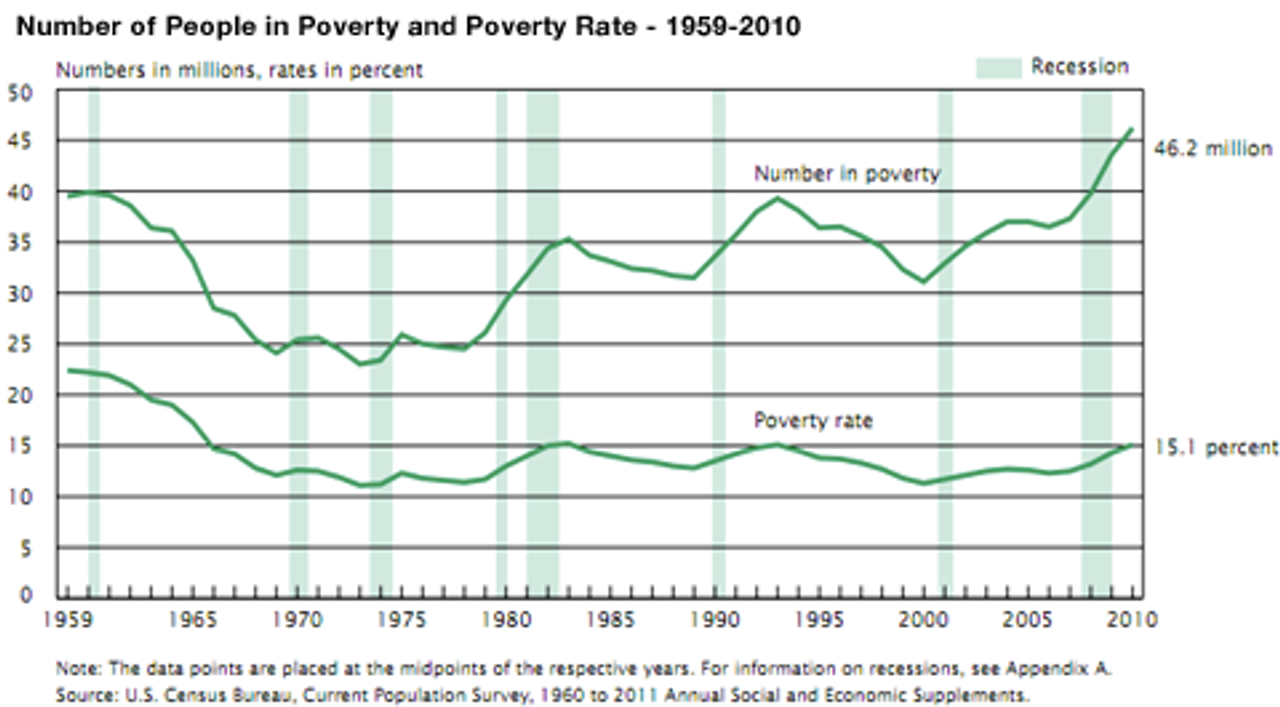
[REPRINT]The poverty rate in the US soared to 15.1 percent in 2010, its highest level since 1993, according to a report released by the Census Bureau on Tuesday. Household incomes continued to fall sharply, amidst the worst jobs crisis since the Great Depression of the 1930s, and the number of people without health insurance increased.
The bureau's report documents a shocking decline in the living standards of millions of people, a devastating indictment of the policies of the Obama administration and the entire political establishment. The new figures cover conditions one year after the supposed beginning of the recovery in June 2009.
The poverty rate increased nearly a full percentage point, from 14.3 percent in 2009. It was the third consecutive annual increase in the poverty rate and the fourth consecutive annual increase in the number of people living in poverty. Last year, there were 46.2 million people living in poverty, defined at the absurdly low level of about $22,000 a year for a family of four and $11,000 a year for an individual.
The number of people earning less than twice the poverty rate (about $44,000 for a family of four) stood at 103 million in 2010, or about 34 percent of the population.
The percentage of children under 18 living in poverty increased from 20.7 percent to 22.0 percent. A total of 16.4 million children live in poverty, equivalent to the population of New York City, Los Angeles, Chicago and Houston combined.
The total number of people in poverty is equivalent to the combined population of the 50 largest cities in the United States. There are more people in poverty in the US in 2010 than during any year on record going back to 1959.
Since 2007, the poverty rate has increased from 12.5 percent to 15.1 percent, or 2.6 percentage points.
The poverty rate for African-Americans increased at a particularly rapid rate, from 25.8 percent in 2009 to 27.4 percent in 2010.
Millions of people live in what is known as “deep poverty,” with incomes less than 50 percent of the official poverty level (or less than about $11,000 a year for a family of four). The deep poverty rate increased from 6.3 percent in 2009 to 6.7 percent in 2010, an increase of 1.5 million to a total of 20.5 million people.
While children under 18 represent 24.4 percent of the overall population, they make up 36 percent of the population (7.5 million individuals) living in deep poverty.
The absolute number of people living in deep poverty and the deep poverty rate are both at the highest level since the government began tabulating these figures in 1975.
The Census report also documented a continued decline in income for working people, with the real median household income falling to $49,445 in 2010, down 2.3 percent ($1,154) from 2009. Since 2007, the report notes, “real median income has declined 6.4 percent and is 7.1 percent below the median household income peak that occurred in 1999.”
These averages mask the enormous inequality that has become the central feature of American society. The lowest 20 percent of households, with incomes of $20,000 or less, saw their share of total income fall from 3.4 percent to 3.3 percent. The top 20 percent took home more than 50 percent of all money income.
A report by the Center for Budget and Policy Priorities notes that since 1999, real income “has fallen 12.1 percent for those at the 10th income percentile but only 1.5 percent for those at the 90th percentile. The income gap between those at the 10th and 90th percentile was this highest on record.”
Since 1999, real household income has fallen 5.5 percent for non-Hispanic whites, 14.6 percent for African Americans, 8.9 percent for Asians and 10.1 percent for Hispanics, according to the Census report.
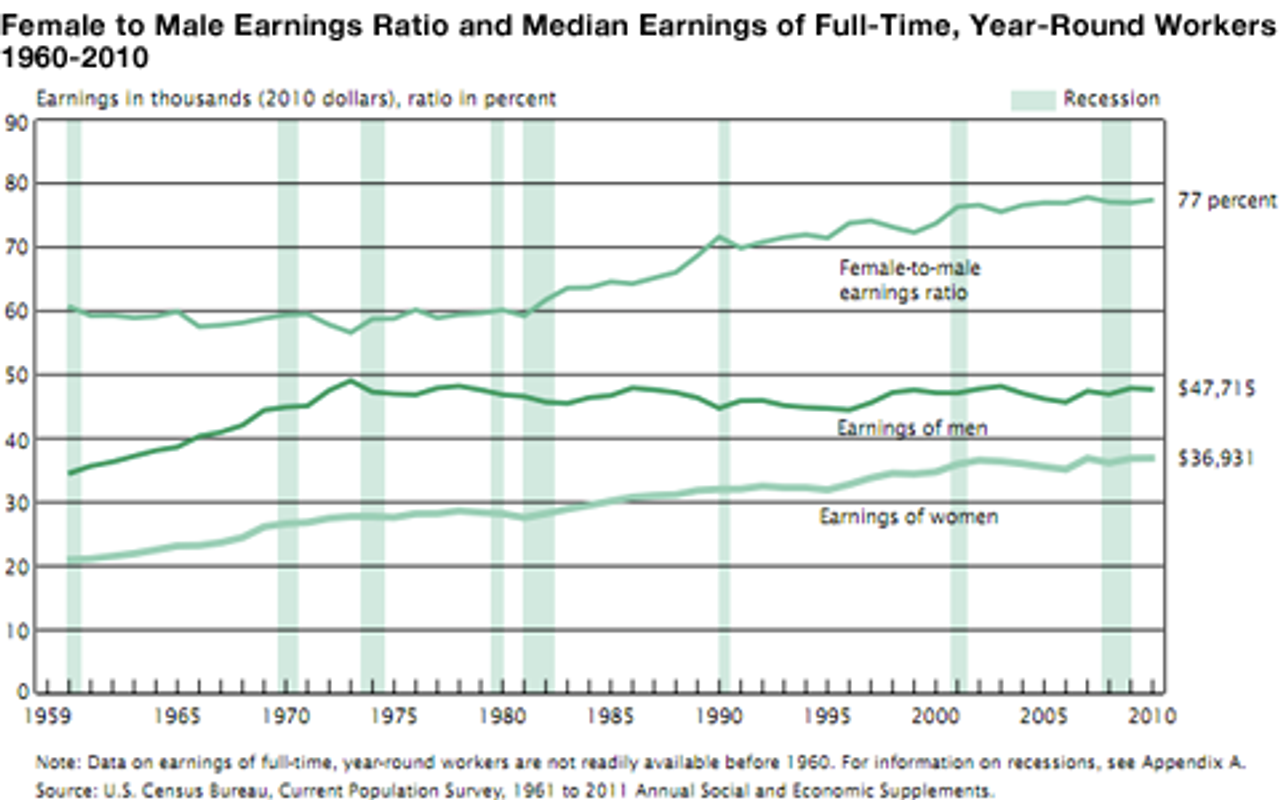
For men with full-time, year-round jobs, the real median income is about the same today as it was in 1973, having remained largely flat for three decades.
Mass unemployment is a major driving force behind the decline in living standards, as corporations utilize the jobs crisis to push through wage and benefit cuts for those who are able to find work. Since 2007, the number of year-round, full-time workers fell by 9.4 million, a fall without parallel since the Great Depression.
These conditions have continued into 2011. Official unemployment stands at 9.1 percent, with the most recent jobs report from the Labor Department showing zero net job growth last month. The level of long-term unemployment is at a historic high. The percent of the population unemployed increased from 16.1 percent to 16.3 percent.
The number of people without health insurance in the United States was 49.9 million in 2010, an increase of nearly one million over 2009. The rise in the uninsured is a particularly damning exposure of the fraud of Obama's health care “reform,” which was in fact an opening shot in a drive to reduce health care costs for corporations and the government.
The rise in poverty is a product of the long-term decline of American capitalism, combined with the ferocious class war waged by the ruling class, now led by the Obama administration. Mass impoverishment is the outcome of a deliberate policy that has resulted in a vast transfer of wealth into the hands of a small corporate and financial aristocracy.
These indices of mass social distress come at a time of record profits, with corporations sitting on a cash hoard estimated at more than $2 trillion. The government has handed over trillions of dollars to the banks, inflating the stock market while bailing out the wealthy. Far from leading to an economic revival, the conditions for the vast majority of the population have suffered a catastrophic decline.
Amidst clear signs of a world economy sinking into a depression, the response of the ruling class is to push for massive austerity. States and local governments throughout the country are implementing cuts in the most basic programs to prevent poverty. The Michigan state government, for example, passed a measure this month that will cut 41,000 people from welfare assistance, including nearly 30,000 children, beginning October 1.
Meanwhile, after outlining a phony jobs proposal that will do nothing to address the unemployment crisis, the Obama administration is set to propose trillions of dollars in cuts to health care and retirement programs.
The administration has made a point of insisting that a proposal being worked on by a bipartisan budget deficit committee must include deep cuts in Medicare and Medicaid, the main federal health care programs.
To fight against these conditions, the working class must enter into industrial and political struggle.
The Socialist Equality Party calls for emergency measures to eliminate poverty, including a multi-trillion dollar public works program to employ tens of millions of workers in high-paying, productive jobs rebuilding infrastructure and meeting other critical social needs. A livable income to meet all basic needs is a social right that must be guaranteed to everyone.
To pay for this program, the SEP fights for a radical redistribution of wealth, including a 90 percent tax on all incomes over $500,000. Corporations, currently engaged in a hiring strike, must be taken over by the working class and run democratically in the interests of social need.
The implementation of these measures is impossible outside of a direct attack on the interests of the wealthy and on the capitalist two-party system, through the building of a mass socialist political movement of the working class.
Tuesday, September 13
Reason TV: Top Threats to Civil Liberties After 9/11 - Q&A with ACLU's Mike German, a former FBI agent - Hit & Run : Reason Magazine
Top Threats to Civil Liberties After 9/11
Paul Detrick | September 12, 2011
[REPRINT]
"The government has no right to pick through your private information just because that's technologically possible," says American Civil Liberties Union policy counsel and former FBI agent Mike German. "The laws are now so lax that they can."
German sat down with Reason.tv to discuss the top threats to civil liberties after 9/11. They range from new interpretations of the Fourth Amendment to law enforcement's fascination with vast empires of data to "fusion centers" that pool sources among intelligence agencies and local police.
About 6.30 minutes.
Produced by Paul Detrick. Shot by Joshua Swain. Edited by Detrick and Tracy Oppenheimer.
Go to Reason.tv for HD, MP4, and audio versions of this video and subscribe to Reason.tv's Youtube channel to receive automatic notification when new material goes live.
Paul Detrick | September 12, 2011
[REPRINT]
"The government has no right to pick through your private information just because that's technologically possible," says American Civil Liberties Union policy counsel and former FBI agent Mike German. "The laws are now so lax that they can."
German sat down with Reason.tv to discuss the top threats to civil liberties after 9/11. They range from new interpretations of the Fourth Amendment to law enforcement's fascination with vast empires of data to "fusion centers" that pool sources among intelligence agencies and local police.
About 6.30 minutes.
Produced by Paul Detrick. Shot by Joshua Swain. Edited by Detrick and Tracy Oppenheimer.
Go to Reason.tv for HD, MP4, and audio versions of this video and subscribe to Reason.tv's Youtube channel to receive automatic notification when new material goes live.
Sunday, September 11
War ‘on’ terror, or ‘for’ terror?
[REPRINT]
Iraq, Kirkuk: A US solider man his rifle while on patrol in the restive northern oil-rich city of Kirkuk, on July 27, 2011. (AFP Photo / Ali Al-Saadi)
Friday, September 9
Wasn't The PATRIOT Act Supposed To Be About Stopping Terrorism? | Techdirt

Wasn't The PATRIOT Act Supposed To Be About Stopping Terrorism?
[REPRINT]

Yup. They're all pretty much being used in drug cases. Now some might make the argument that it's important to go after drug dealers -- but that's not how the PATRIOT Act was supposed to be used.
Wednesday, September 7
Women and the Bible: Status of Women in the Old Testament Laws

Women and the Bible: Status of Women in the Old Testament Laws
By Austin Cline, About.com Guide
[REPRINT]
If a god created humanity, then it created half of all that humanity as one gender (male) and half of another gender (female). And how was the latter half treated by the former half through history? Pretty badly, for the most part. It isn’t surprising to find this trend continued among the ancient Hebrews, but should we expect an all-loving God to support and reinforce such misogyny?
In Numbers, chapter 5, we find this god giving Moses commands about what to do with jealous husbands. The first thing to note is that this god apparently doesn’t care about jealous wives — if they suspect their husband of infidelity, their god offers them no recourse.
The second thing to note is that the husband requires no evidence that his wife has been unfaithful. The whole passage is about a husband who is jealous, nothing more. He merely has to think that his wife has been less than faithful in order for him to bring here before the priests for testing.
And what’s the test? The priest is to gather up dirt from the tabernacle floor, mix it with water, and force the woman to drink the concoction. With the state of sanitation at the time, I’m not sure I want to know what might have lived in that dirt — but any woman with a jealous husband had to consume it. If she was guiltless, nothing would happen as a result of the cursed water. If she was guilty, she would become ill.
Such “trials by fire” were not uncommon in primitive cultures - but should we expect an all-loving god of all humanity to encourage them, much less promote their use on only half his creation? The above is certainly not the only case where women are treated as being inferior to men:
Suppose a man enters into marriage with a woman, but she does not please him because he finds something objectionable about her, and so he writes her a certificate of divorce, puts it in her hand, and sends her out of his house; she then leaves his house and goes off to become another man’s wife.
(Deut. 24:1-2)
If [the city] accepts your terms of peace and surrenders to you, then all the people in it shall serve you at forced labor. If it does not submit to you peacefully, but makes war against you, then you shall besiege it; and when the LORD your God gives it into your hand, you shall put all its males to the sword. You may, however, take as your booty the women, the children, livestock, and everything else in the town, all its spoil. You may enjoy the spoil of your enemies, which the LORD your God has given you.
(Deut. 20:11-14)
Speak to the people of Israel, saying: If a woman conceives and bears a male child, she shall be ceremonially unclean seven days; as at the time of her menstruation, she shall be unclean. Her time of blood purification shall be thirty-three days; she shall not touch any holy thing, or come into the sanctuary, until the days of her purification are completed. If she bears a female child, she shall be unclean two weeks, as in her menstruation; her time of blood purification shall be sixty-six days.
(Lev. 12:2-5)
A man can divorce a woman merely because he finds something, anything, objectionable about her. A woman, however, appears to be stuck no matter how objectionable the husband is. Women are treated like war booty — if they are virgins, that is. Although this may be preferable to being killed like all the men, it does indicate that virgin women are regarded as little more then property. Bearing a female child renders a mother unclean for twice as long as bearing a male child — apparently, this god views women as being inherently unclean and less worthy. It is not to be wondered at, then, that only men could be priests.
It should not be surprising to find such laws among those written by humans from other cultures — in particular, men. Humans are prejudiced against those who are different, and men have long harbored prejudices against women. Some prejudices have continued to this day. But would a god worthy of even a modicum of our respect really promote laws which treated half of humanity as property and less worthy than the other half.
Sunday, September 4
Saturday, September 3
Subscribe to:
Posts (Atom)
